Jinging: Custom Jewelry Manufacturing — Private Label, Oem, ve ODM
OEM/ODM Takı Üreticisi Kendi Mücevherlerinizi Özel Tasarlayın
Başlayalım : mo@kingjy.com
Jinging: Custom Jewelry Manufacturing — Private Label, Oem, ve ODM
giriiş: The Strategic Shift Toward Outsourced Jewelry Production
The global jewelry industry is undergoing a structural transformation. As branded jewelry now accounts for approximately 25% of the total market, and the overall jewelry and silverware sector is projected to grow from $227.65 milyar 2025 ile $240.48 milyar 2026 at a compound annual growth rate of 5.6%, brands of every size are seeking manufacturing partners capable of delivering consistent quality at scale. Eş zamanlı olarak, the global OEM/ODM jewelry services market was valued at approximately $9.4 milyar 2025, reflecting the degree to which even established jewelry houses now rely on specialized manufacturers for production.
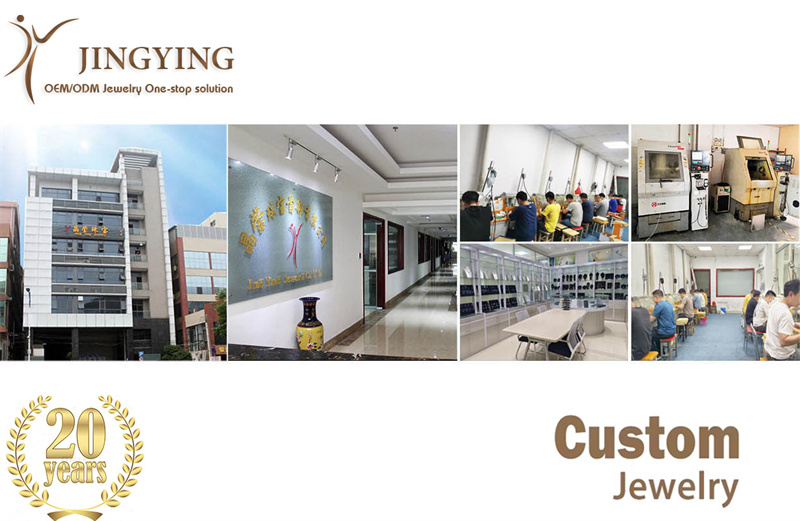
Within this landscape, Guangzhou Jinging Jewelry Co., Ltd. has positioned itself as a full-service manufacturing partner for brands requiring private label, Oem, and ODM solutions. Kuruluş yılı 1998, the company has operated for over two decades as a one-stop provider of custom jewelry manufacturing, with a monthly production capacity of up to 80,000 pieces and a core competency in 925 sterling silver and gold-plated jewelry. This article examines JINGYING’s manufacturing model, the distinctions between private label, Oem, and ODM arrangements, and the operational capabilities that make such partnerships viable for brands operating in an increasingly competitive global market.
Understanding the Three Manufacturing Models
Before evaluating any specific manufacturer, brands must understand the fundamental distinctions between the three primary outsourcing models, each of which carries different implications for design ownership, speed to market, and cost structure.
Private label refers to products manufactured by a third-party producer and sold under the buyer’s own brand name. The brand owns the branding, ambalajlama, and customer relationship, while the manufacturer remains in the background. In a private label arrangement, products are made specifically for the brand — often with custom packaging and specifications — rather than simply rebranded off-the-shelf items. This model is particularly suited to boutique owners, fashion brands extending into jewelry, and e-commerce entrepreneurs who want full control over the product and brand narrative without building production infrastructure.
Oem (Orijinal Ekipman Üreticisi) arrangements place design ownership squarely with the brand. The brand provides the design — whether as sketches, CAD dosyaları, or detailed technical specifications — and the manufacturer produces it exactly to specification. Marka fikri mülkiyete sahiptir, and the manufacturer’s role is production execution. OEM is best suited to brands with established designs who need a reliable production partner capable of maintaining tight tolerances and consistent quality.
ODM (Özgün Tasarım Üreticisi) arrangements involve the manufacturer developing existing designs that the brand can then customize and sell under its own name. Bu modelde, the manufacturer provides design and production capabilities, while the brand contributes brief, direction, ve markalaşma. ODM is ideal for brands looking to develop new concepts collaboratively or those who need market-ready products without an in-house design team.
Private label sits closest to the ODM model, but the degree of customization and design ownership varies depending on the agreement between brand and manufacturer. Pratikte, many successful jewelry brands use a hybrid approach: starting with ODM to achieve speed to market, then transitioning to OEM as their design language matures and differentiation becomes a priority.
JINGYING'in Üretim Yetenekleri
JINGYING operates across all three models, providing what the company describes as a “one-stop solution” for brand jewelers in terms of OEM/ODM and customized work. The company’s manufacturing foundation rests on 925 som gümüş, a material chosen not incidentally but because its 92.5% pure silver content offers an optimal balance of durability and luxury. Gümüş hipoalerjeniktir, hassas ciltler için uygun hale getirir, yine de günlük kullanım için yeterince sağlam. Beyond silver, JINGYING’s capabilities extend to copper with gold plating and solid gold options in 9K, 10K, 14K, and 18K fineness, allowing the company to accommodate market segments from accessible fashion jewelry to higher-end collections.
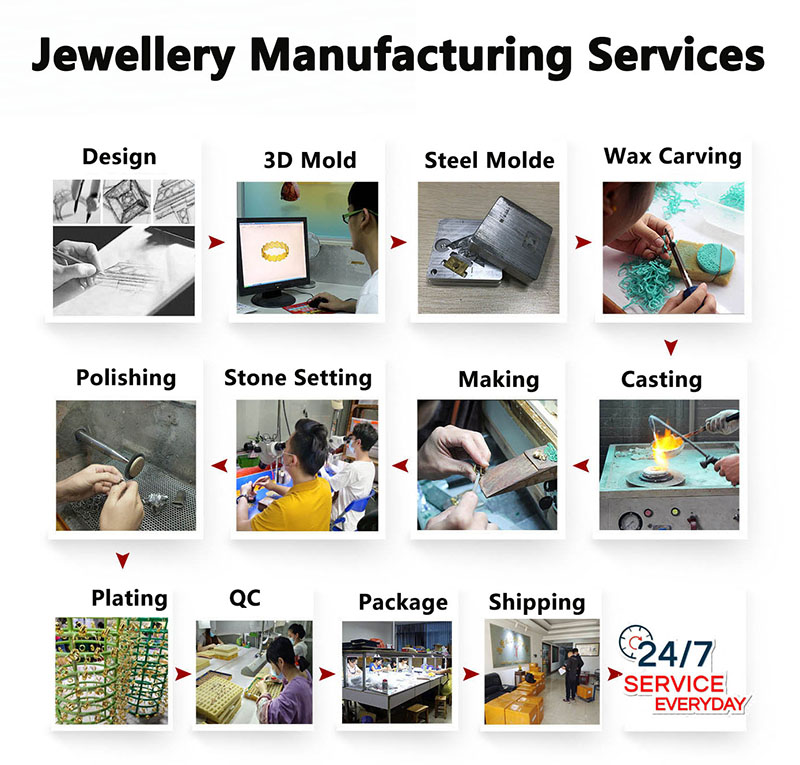
A distinguishing technical feature of JINGYING’s production is its advanced plating technology. The company’s gold vermeil plating reaches thicknesses of up to 3.0 mikron, significantly exceeding typical industry standards for gold-plated silver. This thickness translates directly to durability: JINGYING’s plating process involves a double electroplating procedure — first a thick silver base plating followed by polishing, then a final gold plating — designed to ensure the gold-like appearance endures through regular wear. For brands selling in markets where consumers expect longevity from plated jewelry, this technical specification represents a meaningful competitive advantage.
The company’s design and prototyping workflow reflects a similar emphasis on precision. JINGYING’s in-house design team utilizes professional software including Rhino and JewelCAD to create detailed 3D models from client concepts, fotoğraflar, or existing CAD files. Once a design is approved, CAD files are output to high-precision CNC machines to carve resin or wax prototypes, which are then vacuum-cast in the specified metal for sample approval. For OEM clients bringing their own designs, the technical team conducts design-for-manufacturability reviews and can refine specifications — for example, adjusting prong thickness from 0.3mm to 0.5mm to improve durability — before production begins.
Quality Control as a Competitive Differentiator
In custom jewelry manufacturing, quality control is not a final inspection step but an integrated discipline that spans the entire production cycle. JINGYING’s approach illustrates how a manufacturer can build quality assurance into each stage of the process.
Incoming material inspection involves X-ray fluorescence testing to verify metal composition, ensuring that sterling silver meets the 92.5% standard and that plated materials contain no prohibited substances. This is particularly important for brands selling into the European Union, where REACH regulations restrict nickel release to no more than 0.5 μg/cm²/week and limit cadmium content to 0.01% ağırlıkça. For UK and EU clients, compliance with these standards is not optional, and a manufacturer’s ability to document material provenance and test results directly affects a brand’s ability to access those markets.
In-process quality checks include hourly plating thickness measurements during electroplating, dimensional verification against CAD specifications with tolerances as tight as ±0.15mm, and stone tightness testing using pull-force gauges. Final audit procedures involve a multi-person inspection team and, for some orders, destructive testing on a sample percentage of finished pieces. This layered approach means that defects are identified and corrected at the point of occurrence rather than discovered after shipment, reducing the risk of costly returns and brand damage.
The company also emphasizes confidentiality as a component of its client relationships. JINGYING signs non-disclosure agreements prior to the start of any manufacturing process, ensuring that proprietary designs are not shared with other clients or used in the manufacturer’s own product lines. For brands whose competitive advantage depends on exclusive designs, this contractual protection is as important as the physical quality of the product.
Production Scale, Esneklik, and Cost Dynamics
Operational scale is a defining characteristic of a genuine manufacturer, and JINGYING demonstrates this through its production capacity. Aylık çıktı miktarına kadar 80,000 parçalar, the company is positioned to serve both emerging brands placing initial orders and established retailers requiring consistent replenishment. This capacity is supported by a workforce of between 50 Ve 100 çalışanlar, according to company data, with export sales accounting for approximately 10% of revenue as of the most recent available figures.
Flexibility in order quantities is a practical concern for many brands, particularly those launching new collections or testing market response. Industry norms for custom jewelry manufacturing in China typically involve minimum order quantities ranging from 50 ile 200 pieces per style, depending on material and design complexity. While JINGYING’s specific MOQ varies by project, its stated model supports made-to-order production, meaning that production begins only after design approval and sample confirmation — a structure that aligns manufacturing volume with actual demand rather than speculative inventory.
Cost structures in custom jewelry manufacturing reflect the interplay of material selection, sipariş hacmi, and design complexity. For a representative product category such as gold-plated bracelets, per-unit costs may range from approximately $120 at order volumes of 50 pieces to around $78 at very high volumes. This volume-based pricing curve is characteristic of manufacturing economics in which fixed setup costs — CAD modeling, kalıp oluşturma, sample production — are amortized across larger production runs.
Market Context: Why Custom Manufacturing Matters Now
The demand for private label, Oem, and ODM jewelry manufacturing services is being driven by several intersecting trends in the global jewelry market. Branded jewelry’s growing share of the market — now approximately one-quarter of total sales — indicates that consumers are increasingly making purchase decisions based on brand identity rather than purely on material or price. This shift creates opportunities for new and mid-sized brands that can differentiate through design, hikaye anlatımı, and customer experience, but it also creates pressure to source production partners capable of translating brand vision into physical product reliably and at competitive cost.
Online jewelry sales have accelerated this dynamic. BİZ. e-commerce jewelry revenue reached approximately $16.8 milyar 2025, representing roughly one-fifth of the total market. Digital-native brands often operate with leaner organizational structures than traditional retailers, making external manufacturing partnerships essential rather than optional. These brands require manufacturers that can support rapid iteration, accommodate small initial order quantities, and integrate with digital design workflows — capabilities that JINGYING’s CAD-driven prototyping and made-to-order production model are designed to address.
Aynı zamanda, the global jewelry market’s projected growth trajectory — from $227.65 milyar 2025 ile $240.48 milyar 2026 at a 5.6% CAGR — suggests that demand for manufacturing capacity will remain robust. The OEM/ODM services segment specifically is expected to grow from approximately $9.4 milyar 2025 ile $10.7 milyar tarafından 2032, a more modest 1.9% CAGR that reflects the maturity of the outsourcing model in established markets and its expansion into new categories and geographies.
Çözüm: Choosing the Right Manufacturing Partnership
For brands evaluating custom jewelry manufacturing partners, the decision ultimately comes down to alignment between the manufacturer’s capabilities and the brand’s stage of development, pazar konumlandırma, and operational priorities. Private label offers the fastest and lowest-risk entry point for brands that want to test the jewelry category with existing designs. OEM provides the control and design ownership required by brands with established creative direction and a clear point of view. ODM offers the design and production partnership that emerging brands need to bring concepts to market without building internal capabilities.
JINGYING’s model — combining over two decades of production experience, 925 sterling silver and gold-plated manufacturing expertise, 3.0-micron plating technology, CAD-driven prototyping, and multilayer quality control — positions the company as a viable partner across all three arrangements. The company’s emphasis on confidentiality agreements, export compliance with REACH and related standards, and flexible order quantities addresses the practical concerns that most often determine whether a manufacturing partnership succeeds or fails. In a jewelry market where brand differentiation is increasingly tied to product quality and supply chain reliability, the choice of manufacturing partner is not merely a sourcing decision but a strategic one.