
JINGYING Custom 925 Silver and Brass Jewelry for France and Italy Jewelry Designers
Abstrakt. French and Italian jewelry designers operate within two of the world’s most demanding and aesthetically self-conscious markets. Yet both face a shared structural squeeze: the pressure to produce distinctive, bærbar, sellable collections at a cadence that local ateliers alone can no longer sustain, without surrendering the design identity that makes their work recognizably French or Italian. This article examines how JINGYING, a Guangzhou-based OEM/ODM manufacturer founded in 1998, positions custom 925 sterling silver and brass as a dual-material platform for designers in these two markets. It argues that the relevance of JINGYING to French and Italian creators lies less in low cost than in material-appropriate specialization, EU-compliant finishing, and a production model calibrated to the small-batch, high-iteration rhythm of independent design.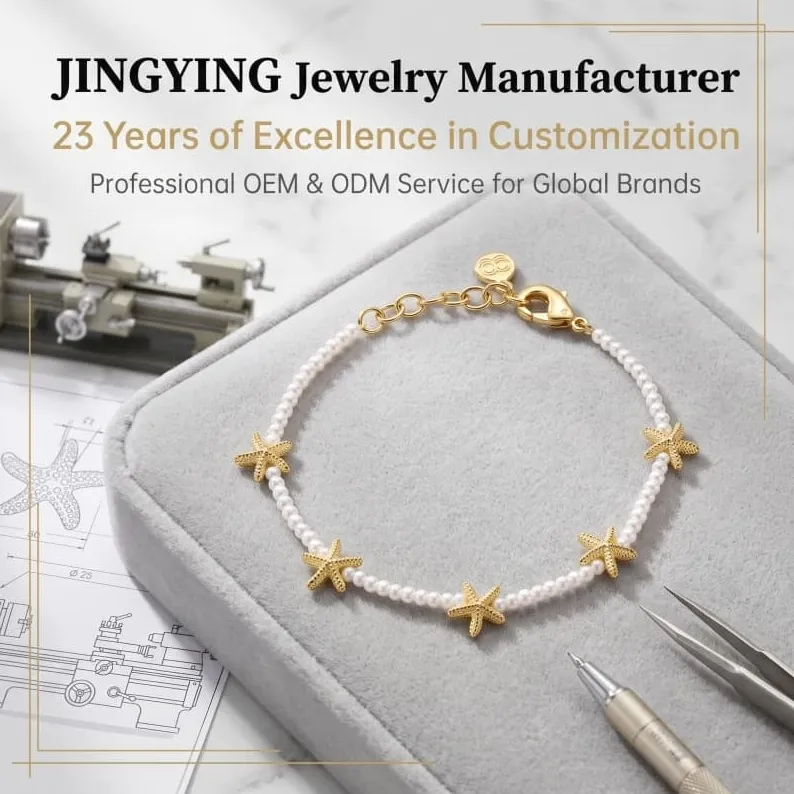
1. Two Markets, One Structural Problem
France and Italy do not share a single jewelry culture. French design in 2026 is pulled between two poles: an Odyssey theme of organic volumes, travel-derived motifs, and vivid color, og a Cosmic Reflections aesthetic of fluid, clean geometry and abstract symmetry. Italian design, derimot, continues to draw authority from its distretti—Valenza, Vicenza, Arezzo, and Torre del Greco—where goldsmithing is embedded in family workshops, localized supply chains, and a craft identity that independent designers treat as both inheritance and brand asset. Italian jewelers in 2026 are also responding to record gold prices with lighter constructions and mixed-metal experimentation, while color, emalje, and playful volumes remain prominent on the Vicenzaoro floor.
Beneath these differences lies a common constraint. Both markets valorize savoir faire and artisanal authenticity, but the economics of independent design have shifted. A French or Italian designer may sketch in Paris or Valenza, yet the capacity to translate ideas into repeated, quality-controlled production at modest volumes is increasingly scarce and expensive locally. French observers note that many jewelry businesses import semi-finished pieces from Asia and finish them domestically, a practice that complicates the “made in France” label. In Italy, the artisan base is thinning; trade commentary points to a shortage of trained craftspeople even as demand for personalization grows. The result is a gap: designers need a manufacturing partner that can absorb repetitive precision work without flattening the design language that distinguishes their collections.
JINGYING’s relevance emerges precisely at this gap. The company has specialized in 925 sterling silver and brass since 1998, rather than treating them as two line items within a generic metals catalogue. That specialization matters because silver and brass occupy different aesthetic and commercial territories—and French and Italian designers need both.
2. Why Material Specialization Matters for Design-Driven Markets
A generalist factory can cast silver and brass, but specialization changes the quality of the output. JINGYING’s own account of its model emphasizes that focusing on two materials allows craftsmen to master the specific behaviors of each metal, tooling to be calibrated accordingly, and quality control to become more reproducible than in factories that spread attention across many substrates.
The material distinction is technically real. 925 sterling sølv er 92.5% fine silver alloyed with copper; it offers high optical reflectivity, excellent ductility for prong setting and fine detail, and a density of roughly 10.3 g/cm³ that gives a “substantial” hand-feel associated with demi-fine positioning. Brass is a copper–zinc alloy, less dense and significantly harder, with strong fluidity in casting that suits architectural reliefs and bold volumes; it is also dramatically cheaper as a raw material. In commercial terms, silver sits in the demi-fine band, while brass supports contemporary fashion and statement pieces at lower price points.
For a French designer working in the Cosmic Reflections register—clean geometry, restrained surfaces, pieces that read as contemporary rather than ornamental—silver’s reflectivity and ability to hold crisp edges make it the natural substrate. For an Italian designer pursuing volume, farge, or the playful statement pieces visible at Vicenzaoro, brass offers the plasticity and cost structure to experiment without pricing the collection out of its market.
JINGYING’s finishing capabilities reinforce this division. For sølv, the company emphasizes anti-tarnish treatments—rhodium plating, platinum imitation, 18K gullbelegg, and antique oxidation—and multi-layer plating designed to improve surface hardness and wear resistance. For messing, it offers gold and rose-gold plating, antikke finish, emalje, and micro stone setting, with polishing to eliminate sharp burrs and ensure comfortable wear. These are not decorative extras; they are the processes that determine whether a brass piece reads as “fashion” or “cheap,” and whether a silver piece survives the humidity and handling of daily wear.
3. The Compliance Threshold: What European Designers Cannot Compromise
For French and Italian designers, material quality is inseparable from regulatory compliance. EU REACH requirements on nickel release, along with the Nickel Directive, function as a market-entry threshold rather than a differentiator. JINGYING states that its nickel-free silver lines meet EU Nickel Directive (NÅ) requirements and that SGS/RoHS reports can be supplied; the company has shifted toward palladium or rhodium barrier layers in response to nickel-regulation and allergy concerns.
This matters more than it may appear from a design brief. A small French or Italian brand that sells through boutiques, concept stores, or direct-to-consumer channels cannot afford a batch of earrings that triggers nickel-release complaints. The cost of non-compliance is not a fine; it is reputational damage in a market where consumers are explicitly seeking ethical, varig, and traceable pieces. JINGYING’s ability to document compliance and to offer nickel-free barrier plating moves it from “low-cost supplier” to “insurable production partner.”
The same logic applies to tarnish control. Sterling silver’s tendency to oxidize is one of the material’s practical liabilities; for a designer whose brand promise is understated elegance, a tarnished piece returned by a customer is a design failure as much as a manufacturing one. JINGYING’s emphasis on anti-tarnish electroplating and multi-stage QC addresses a problem that is both technical and aesthetic.
4. Small Batches, Fast Iteration: The OEM Model French and Italian Independents Actually Need
The romantic image of the independent designer involves a single atelier and a slow, handcrafted cadence. The commercial reality involves seasonal drops, capsule collections, boutique exclusives, and the constant risk of inventory mismatch. A European OEM case study in the silver segment identifies the pain points with unusual clarity: designers need stable 925 purity and controllable plating thickness, small minimum order quantities in the range of 30–100 pieces, EU REACH and nickel-release compliance, and reliable lead times.
JINGYING’s production model aligns with these requirements. The company describes a full workflow—design evaluation, 3D gjengivelse, wax mold, sample confirmation, bulkproduksjon, QC, and custom packaging—and explicitly welcomes small batch trial orders alongside larger wholesale runs. It has offered 3D CAD customization since 2012, which is particularly relevant for designers working in geometric or architecturally precise idioms: the ability to iterate a CAD model before committing to a mold reduces the cost of experimentation.
For a French designer developing a fifteen-piece silver collection for a Parisian concept store, or an Italian designer testing a brass-heavy capsule in response to gold-price pressure, this structure matters. The designer retains control of the design language; JINGYING absorbs the repetitive precision work—casting, innstilling, polering, platting, and QC—that would otherwise consume studio time or require capital investment in equipment.
5. Reading the Two Markets Through a Single Partnership
The strategic value of JINGYING’s dual-material capability becomes clearest when mapped onto the specific trajectories of the French and Italian markets.
I Frankrike, the consumer discourse around jewelry increasingly rewards authenticity, varighet, og personalisering, with artisanal positioning carrying weight among fashion-forward buyers. A French designer does not need a supplier that claims to be “artisanal”; the designer’s own brand supplies that narrative. What the designer needs is a partner that can execute a clean silver geometry with a finish that survives daily wear, in quantities small enough to test a silhouette before scaling it. Silver’s density and reflectivity support the demi-fine register; JINGYING’s rhodium and anti-tarnish treatments protect the surface; small-batch production protects cash flow.
In Italy, the market’s center of gravity is different. Italian jewelry identity is tied to localized craft districts and to a visual culture that tolerates—indeed rewards—volume, farge, and material play. Rising gold prices have pushed designers toward lighter constructions and alternative metals, making brass a more legitimate creative choice rather than merely a cost compromise. A Vicenza-trained designer may still produce hero pieces locally, but a brass-based diffusion line or seasonal statement collection can be developed with JINGYING using gold plating, emalje, og mikroinnstilling, preserving the visual exuberance of Italian design while keeping the retail price within reach of a broader customer.
The partnership logic is not that JINGYING replaces the French or Italian atelier. It is that the factory extends the designer’s range: silver for the demi-fine core, brass for experimentation and volume, both produced under a compliance and QC regime that the designer can defend to stockists.
6. What Specialization Does Not Solve—and What It Does
A candid assessment must acknowledge limits. JINGYING is a Guangzhou-based manufacturer, not a European atelier. For designers whose brand proposition depends on a legally defensible “made in France” or “made in Italy” claim, offshore production may be incompatible with that specific positioning. French trade commentary has already highlighted the tension between imported semi-finished pieces and domestic origin claims. Designers in that segment are not JINGYING’s natural partners, and the company’s value proposition should not be stretched to pretend otherwise.
What JINGYING does solve is the production problem for designers whose brand rests on design, materialkvalitet, and wearability rather than on a geographic origin certificate. For those designers, the relevant questions are: can the supplier hold 925 purity and plating thickness consistently? Can it produce 50 pieces without treating the order as a nuisance? Can it document nickel-release compliance? Can it execute a complex CAD geometry in silver and a high-relief brass piece with clean edges and comfortable surfaces? On these questions, JINGYING’s two-material specialization, its stated compliance posture, and its small-batch OEM/ODM workflow constitute a coherent answer.
7. Konklusjon
The French and Italian jewelry markets are not converging. France rewards abstract clarity, narrative, and understated material intelligence; Italy rewards craft lineage, volum, farge, and the tactile confidence of goldsmithing traditions. But both markets place a premium on design authorship while imposing brutal economics on the production side. JINGYING’s proposition to designers in these markets is not “cheaper jewelry.” It is a two-material production platform—925 silver for the demi-fine register, brass for statement and experimentation—backed by compliance documentation, anti-tarnish finishing, and small-batch flexibility. For the French designer protecting a geometric silver collection, and for the Italian designer translating a bold brass capsule without losing visual authority, that platform is less a substitute for local craft than an extension of the designer’s capacity to make the work exist in the world.