
JINGYING Jewelry Manufacturer: Comprehensive Capabilities in CAD Development, Production Process, MOQ, and Lead Times
Abstract
This comprehensive 5,000-word article examines the full-spectrum manufacturing capabilities of JINGYING, a premier jewelry manufacturer based in Guangzhou, China. With over two decades of industry experience, state-of-the-art facilities spanning 35,000 square meters across four specialized factories, and a workforce of 600+ skilled professionals, JINGYING has established itself as a trusted global OEM partner serving over 300 brands across 45 countries . This article provides an in-depth exploration of JINGYING's computer-aided design (CAD) development process, detailed production workflow, flexible minimum order quantity (MOQ) structure, and efficient lead time management. Through analysis of technical capabilities, quality assurance protocols, and real-world case studies, this article demonstrates how JINGYING's integrated manufacturing ecosystem enables clients to transform creative concepts into high-quality jewelry with precision, efficiency, and scalability.
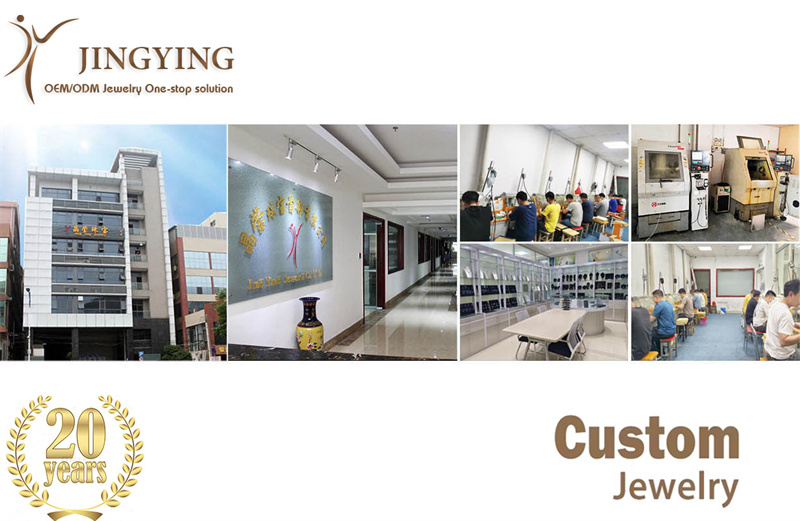
1. Introduction: The Evolution of a Manufacturing Powerhouse
In the intricate and highly competitive world of jewelry manufacturing, JINGYING has emerged as a leading outsourced manufacturing partner for both fine and fashion jewelry brands worldwide . The company's journey from a specialized workshop established in 2005 to an international manufacturing powerhouse mirrors the transformation of the jewelry industry itself—embracing technological innovation while preserving artisanal craftsmanship, adapting to global market demands while maintaining uncompromising quality standards, and growing from a local manufacturer to a global partner .
Today, JINGYING operates four specialized facilities totaling 35,000 square meters, employing over 600 skilled technicians and craftspeople . The company's global reach spans North America (42% of production volume), the European Union (38%), Asia-Pacific (12%), and other emerging markets (8%) . This diversified footprint reflects JINGYING's ability to navigate international trade regulations, cultural preferences, and logistics requirements while maintaining ISO 9001:2015 certification, Responsible Jewellery Council (RJC) membership, and Sustainable Jewelry Council compliance .
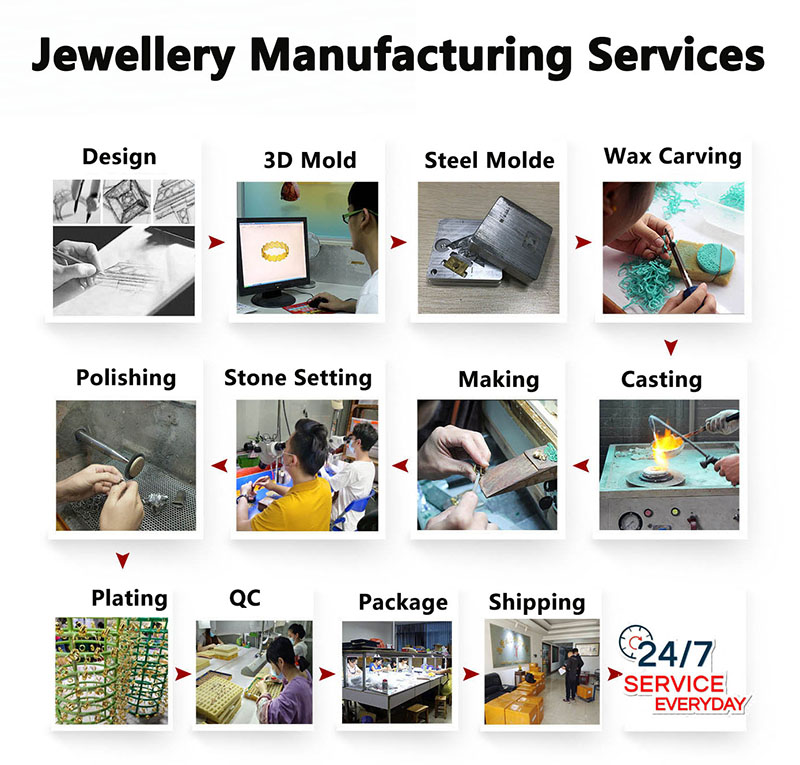
This article provides a comprehensive examination of JINGYING's manufacturing capabilities, organized around four critical pillars: CAD development and design services, the complete production process from concept to finished piece, minimum order quantity structures that democratize access to quality manufacturing, and lead time management that balances efficiency with uncompromising quality.
2. CAD Development: From Concept to Digital Reality
Computer-Aided Design (CAD) and 3D prototyping have revolutionized the way custom jewelry is created. JINGYING specializes in transforming clients' jewelry ideas into precise CAD models and 3D-printed prototypes, bridging the gap between imagination and tangible reality .
2.1 Design Input Methodologies
JINGYING's CAD development process begins with understanding that inspiration manifests in many forms. The company has structured its design input process to accommodate various client inputs:
Photographs and Images: Clients may provide photographs of existing jewelry, natural objects, architectural details, or any visual inspiration. JINGYING's designers analyze these images to identify key lines, textures, and focal points, creating interpretive sketches that capture the essence of the inspiration in wearable form .
Hand-Drawn Sketches: Whether rough doodles or detailed technical drawings, sketches provide direct insight into the client's vision. JINGYING's CAD engineers translate these two-dimensional representations into three-dimensional digital models, adding necessary structural elements like internal galleries for stone settings, appropriate wall thickness, and ergonomic considerations .
Digital Files: For clients with advanced design capabilities, provided files in formats such as .STL, .OBJ, or .Rhino represent the most streamlined path to production. JINGYING conducts comprehensive Digital Design for Manufacturing (DFM) analysis, checking for non-manifold edges, wall thickness issues, undercuts, and stone setting compatibility .
Design Briefs: For clients beginning without visual materials, JINGYING guides them through creation of comprehensive design briefs including mood boards, target audience definitions, competitive analysis, and key descriptive terms that define the design ethos .
2.2 CAD Modeling Technologies and Software
JINGYING employs industry-leading CAD software to create precise digital models:
-
Matrix Gold: For intricate designs requiring complex geometry and detailed stone settings
-
RhinoGold: For parametric modeling and design optimization
-
ZBrush: For organic, sculptural designs requiring high-resolution surface detail
-
Adobe Illustrator: For initial 2D sketching and vectorization
The CAD modeling process follows a structured workflow:
-
Base Structure Creation: Extruding shapes from 2D outlines to establish fundamental form
-
Detailing: Adding textures, engravings, and gemstone setting configurations
-
Boolean Operations: Combining or subtracting geometries for hollow designs and complex structures
-
Sizing Adjustments: Ensuring accurate dimensions for ring sizes, bracelet diameters, and other critical measurements
2.3 Client Review and Design Iteration
Once the initial CAD model is complete, JINGYING produces photorealistic 3D renders that simulate different metal types (yellow gold, rose gold, white gold, platinum) and stone settings. These renders allow clients to see near-perfect representations of final products, assess how light plays across surfaces, and evaluate overall aesthetics .
The review process typically involves multiple iterations, with JINGYING's engineers providing expert guidance on manufacturability, structural integrity, and wearability. This collaborative approach ensures that designs are not only beautiful but also optimized for production and long-term durability .
2.4 3D Prototyping Technologies
After CAD approval, JINGYING produces physical prototypes using advanced 3D printing technologies:
| Technology | Material | Accuracy | Best For |
|---|---|---|---|
| SLA (Stereolithography) | Resin | ±0.1mm | High-detail rings, pendants, complex forms |
| DMLS (Direct Metal Laser Sintering) | Metal Powder | ±0.05mm | Functional prototypes, wear testing |
| Wax Printing | Castable Wax | ±0.2mm | Investment casting preparation |
Source:
The 3D printing process typically takes 2-6 hours depending on size and complexity, followed by post-processing that includes support removal and sanding/polishing to achieve a flawless finish . For the Dutch cross pendant project, JINGYING produced multiple prototype iterations using SLA printing before final approval, ensuring every detail met client expectations .
2.5 Design for Manufacturing (DFM) Expertise
A critical value-add in JINGYING's CAD development process is Design for Manufacturing analysis. The company's engineering team proactively identifies potential production issues and suggests modifications before tooling begins. In the case of a U.S. client's custom earring production, JINGYING identified three required modifications:
-
Prong thickness adjustment from 0.3mm to 0.5mm for enhanced durability
-
Hinge mechanism redesign for easier assembly
-
Weight reduction from 8.2g to 6.5g per earring for improved wearability
These DFM improvements resulted in a 30% cost reduction compared to the client's previous manufacturer and a 15% faster production cycle time .
3. The Production Process: From Prototype to Finished Jewelry
JINGYING's production workflow transforms approved digital designs into physical jewelry through a series of meticulously controlled stages, leveraging the company's vertically integrated infrastructure.
3.1 Manufacturing Infrastructure and Equipment
JINGYING's four specialized factories house state-of-the-art equipment:
Factory 1: Casting and Metalwork (8,000 sqm)
-
25 CNC milling machines with 0.01mm precision
-
22 vacuum casting machines with climate control
-
Advanced wax injection systems
Factory 2: Stone Setting and Assembly (10,000 sqm)
-
Micro-inlay machines imported from Japan
-
8 laser welding and engraving stations
-
Automated assembly lines
Factory 3: Plating and Finishing (7,000 sqm)
-
12 automated electroplating lines with environmental controls
-
Robotic polishing arms
-
Advanced finishing systems
Factory 4: Specialized Production (10,000 sqm)
-
Additional capacity for high-volume orders
-
Dedicated quality control laboratories
3.2 Master Model Production and Casting
With approved CAD files and prototypes, JINGYING moves to creating the physical master for production:
Rubber Mold Making: For designs requiring multiple reproductions, precision-engineered molds are created, with capabilities for up to 50 cavities per mold for high-volume production .
Wax Injection: Automated systems inject wax into molds, creating exact replicas of the master model. For the Dutch cross pendant project, this process achieved 1,200 units per day with an 85% first-pass yield rate .
Investment Casting: Using the traditional lost-wax casting method enhanced with vacuum assistance, wax models are encased in investment material, heated to burn out the wax, and filled with molten metal. JINGYING's vacuum casting machines ensure minimal porosity and exceptional detail capture, achieving 92% material utilization rates .
Metal Options: The company works with a comprehensive range of materials:
-
Precious Metals: 925 sterling silver, 10k-22k gold (yellow, white, rose), 950/900 platinum, vermeil
-
Base Metals: Brass, copper, stainless steel
-
Alternative Materials: Titanium, tungsten, ceramic
3.3 Component Fabrication and Assembly
After casting, pieces enter the fabrication and assembly phase:
For cast components: Individual pieces are carefully cut from casting trees, with sprues removed and surfaces prepared for finishing.
For stamped components: Precision-engineered dies form sheets of metal into identical components with exceptional efficiency and accuracy .
Assembly: Skilled artisans specialize in soldering, linking, and setting, ensuring every joint is secure and every clasp functions flawlessly. For complex designs, laser welding provides precise, clean connections .
3.4 Stone Setting Excellence
JINGYING's stone-setting department represents a pinnacle of craftsmanship, with specialized artisans working under microscopes for precision:
-
Prong Settings: Using tiny metal claws to secure stones while maximizing light exposure
-
Bezel Settings: Encircling stones with custom-fitted metal collars for secure, modern looks
-
Pavé Settings: Placing many small stones close together to create "paved" surfaces of brilliance
-
Channel Settings: Positioning stones in rows between two metal walls
-
Micro-Setting: Ultra-precise setting for very small stones in luxury pieces
For the U.S. earring project, JINGYING achieved 0.3% stone loss rate compared to the industry average of 1.2%, demonstrating exceptional precision in stone handling and setting .
3.5 Finishing and Plating
The finishing phase transforms raw castings into luxurious, finished jewelry:
Pre-polishing and tumbling: Pieces are placed in tumbling machines with stainless steel shot and polishing compounds, smoothing minor surface imperfections and beginning the polishing cycle. Automated polishing systems reduce hand-polishing time by 65% while maintaining consistency .
Hand-polishing: Experienced artisans buff pieces to designated finishes—mirror shine, soft satin, hammered texture, or matte effects—using progressive grit compounds and specialized tools .
Plating: JINGYING employs sophisticated electroplating technology for gold, rhodium, rose gold, and black rhodium finishes. The process includes:
-
Ultrasonic cleaning and electrochemical surface preparation
-
Precise thickness control through duration and current management
-
Thickness options ranging from standard to vermeil (2.5-5.0 microns over sterling silver)
Oxidation and Patina: For antique or vintage effects, controlled oxidation creates depth and character .
3.6 Quality Control Protocol
Quality at JINGYING is not a department but a pervasive culture, embedded in every process:
Incoming Material Inspection:
-
XRF testing for metal purity verification
-
Spectrometer analysis for alloy composition
-
Gemstone quality assessment
-
Dimensional checking of components
In-Process Quality Checks:
-
Casting quality verification
-
Stone setting precision monitoring
-
Plating thickness measurement
-
Assembly accuracy verification
Final Inspection Protocol:
-
100% visual inspection under calibrated lighting
-
Functional testing of clasps and mechanisms
-
Stone security testing (50g pull test for the U.S. project)
-
Dimensional verification (±0.1mm tolerance)
-
Surface defect inspection (<0.5% allowance)
Testing Standards:
-
Salt spray testing for corrosion resistance
-
Adhesion testing for plating durability
-
Wear simulation testing
-
ASTM and ISO compliance testing
3.7 Production Capacity and Volume Capabilities
JINGYING's manufacturing capacity scales to meet diverse client needs:
| Category | Capacity |
|---|---|
| Fine Jewelry | 50,000-75,000 pieces monthly |
| Fashion Jewelry | 100,000-150,000 pieces monthly |
| Maximum Daily Output | 8,000-10,000 pieces |
| Scalability | 40% capacity increase within 30 days |
Source:
This scalability was demonstrated in the Dutch cross pendant project, where JINGYING successfully delivered 25,134 units (0.5% over-delivery) across three phased shipments over five months, achieving 99.2% on-time delivery and 0% quality complaints .
4. Minimum Order Quantities: Democratizing Jewelry Production
Perhaps JINGYING's most significant innovation lies in its approach to minimum order quantities. While traditional manufacturers demand large production runs that exclude emerging designers and small businesses, JINGYING has championed a low-MOQ model that democratizes access to high-quality jewelry manufacturing .
4.1 MOQ Structure and Flexibility
JINGYING's MOQ structure accommodates clients at every stage of business development:
| Client Type | MOQ Range | Best For |
|---|---|---|
| Startups and Emerging Designers | 100-500 pieces per design | Market testing, limited launches |
| Growing Brands | 500-1,000 pieces per design | Seasonal collections, line expansions |
| Established Brands | 1,000+ pieces per design | High-volume production, retail distribution |
Source:
For fashion jewelry, MOQs can be as low as 100 pieces, while fine jewelry typically requires 500 pieces per design . Full-service orders with minimum values as low as $1,500 are available for startups and independent designers .
4.2 Strategic Advantages of Low MOQs
Financial Accessibility and Risk Mitigation: The most significant advantage of low MOQs is financial prudence. Instead of committing tens of thousands of dollars to inventory for a single design, clients can order smaller quantities, dramatically lowering initial capital outlay and preserving cash flow. This creates a test-and-learn approach: validate designs in the real market without the devastating risk of being stuck with unsold inventory .
Creative Freedom and Iterative Development: Small initial batches allow designers to gauge market reception and refine designs based on real sales data and customer feedback before placing larger reorders. This agile development cycle ensures collections evolve in direct response to audience preferences, leading to higher satisfaction and stronger brand loyalty .
Exclusivity and Brand Narrative: In a world of mass production, limited quantities become powerful marketing tools. "Small batch," "limited run," and "artisanal production" are compelling narratives that resonate with conscious consumers, communicating care, quality, and exclusivity .
Scalability Without Friction: Starting with low MOQs builds foundations of trust and streamlined communication. As brands grow, JINGYING grows with them, scaling production capacity to meet increasing demand while maintaining quality standards .
4.3 Ideal Clients for Low MOQ Model
JINGYING's low MOQ structure serves diverse client types:
-
Aspiring Entrepreneurs: Those with vision but lacking industry connections benefit from JINGYING's guidance through material choices, cost breakdowns, and production timelines .
-
Established Small Businesses: Brands with loyal customer bases can expand lines without overextending, introducing new styles seasonally or testing new materials with minimal financial commitment .
-
Independent Designers: Creators focused on artistry benefit from JINGYING's technical extension of their studios, faithfully executing intricate designs with precision .
-
E-commerce and Dropshipping Brands: Speed and adaptability are enabled through relatively quick turnarounds and willingness to produce in aligned batches, allowing capitalizing on trends and maintaining lean inventory .
-
Socially-Conscious Brands: The small-batch model is inherently less wasteful, reducing overproduction and supporting ethical sourcing practices .
5. Lead Times: Balancing Efficiency with Quality
JINGYING's lead time structure reflects the company's commitment to efficiency without compromising quality, providing clients with predictable timelines for production planning.
5.1 Standard Lead Time Framework
| Phase | Standard Lead Time | Rush Option |
|---|---|---|
| CAD Development and Prototyping | 7-10 business days | 5-7 days |
| Sampling | 7-10 business days | 5-7 days |
| Production | 20-30 business days | 15-18 days |
| Reorders | 12-15 business days | 10-12 days |
Source:
For the U.S. earring project, JINGYING delivered 12,000 pairs across three shipments over eight months, maintaining 100% on-time delivery through careful production scheduling and quality control .
5.2 Factors Influencing Lead Times
Several factors affect production timelines:
Design Complexity: Intricate designs with multiple components, complex stone settings, or specialized finishes require additional production time. The Dutch cross pendant project required 35 days production time due to the 25,000-unit volume and precise engraving requirements .
Order Volume: Larger orders naturally require more production time. JINGYING's scalable capacity enables efficient handling of both small batches (100-500 pieces: 15-20 days) and large orders (1,000+ pieces: 25-30 days) .
Material Availability: Precious metals and gemstones with specific sourcing requirements may affect timelines. JINGYING maintains strategic inventory of common materials to minimize delays .
Seasonal Demand: Peak seasons may require advance planning. JINGYING's scalable capacity (40% increase within 30 days) helps accommodate fluctuating demand .
5.3 Rush Order Capabilities
For clients with urgent requirements, JINGYING offers expedited production:
-
Rush Order Lead Time: 15-18 business days (surcharge applies)
-
Express Prototyping: 5-7 business days for CAD and 3D printing
-
Accelerated Sampling: Priority handling for sample approval
The company maintains buffer capacity specifically for rush orders, ensuring quality standards are maintained even under accelerated timelines.
5.4 Shipping and Logistics Options
Once production is complete, JINGYING offers multiple shipping options:
| Method | Transit Time | Best For |
|---|---|---|
| Express Delivery (DHL/FedEx) | 3-5 days | Urgent orders, samples |
| Air Freight | 7-10 days | Standard international shipping |
| Sea Freight (LCL/FCL) | 30-45 days | Large-volume orders, cost optimization |
Source:
For the U.S. earring project, JINGYING recommended a hybrid air-ocean solution: first batch via air for market testing (5 days, $8,400), subsequent shipments via ocean (28 days, $3,200) for cost efficiency .
5.5 Customs and Compliance Documentation
JINGYING manages international shipping complexities including:
-
HS code classification (e.g., 71131110 for silver jewelry)
-
Customs clearance support
-
Import duty documentation (3.2% EU preferential rate)
-
REACH, CPSIA, and Prop 65 compliance documentation
-
Certificate of origin preparation
6. Quality Assurance and Compliance Standards
JINGYING's commitment to quality extends beyond production to comprehensive compliance with international standards.
6.1 Certifications and Accreditations
-
ISO 9001:2015: Quality Management System Certified
-
Responsible Jewellery Council (RJC): Code of Practices Certified
-
Sustainable Jewelry Council: Compliance verified
-
REACH Compliance: EU chemical regulations
-
CPSIA Compliance: U.S. consumer product safety
-
Nickel Directive Compliance: EU nickel release limits
6.2 Testing Protocols
| Test | Method | Standard |
|---|---|---|
| Metal Purity | XRF Spectrometry | 92.5-93.5% Ag, karat verification |
| Plating Thickness | X-ray Fluorescence | 2.5-5.0 microns (vermeil) |
| Corrosion Resistance | Salt Spray Testing | 24-72 hours exposure |
| Adhesion | Cross-cut tape test | No delamination |
| Nickel Release | EN 1811:2011 | <0.5 μg/cm²/week |
Source:
6.3 Defect Rate and Quality Metrics
JINGYING maintains industry-leading quality metrics:
-
First-pass yield rate: 94.7% (U.S. earring project)
-
Defect rate: <0.3%
-
Quality acceptance rate: 99.5%
-
On-time delivery: 98%
7. Case Studies: Manufacturing Excellence in Practice
7.1 U.S. Fashion Brand: Geometric Earrings Production
Client: Massachusetts-based fashion brand
Product: 925 silver geometric drop earrings with cubic zirconia
Quantity: 12,000 pairs (4 color variants)
Challenge: Scale production while maintaining design integrity and U.S. compliance
JINGYING's Solution:
-
CAD optimization: prong thickness 0.3mm→0.5mm, hinge redesign, weight 8.2g→6.5g
-
Prototyping: 4 iterations for form and mechanism verification
-
Production: vacuum casting (92% material utilization), robotic polishing (65% time reduction), laser stone setting (0.3% loss rate)
Results:
-
First-pass yield: 94.7%
-
On-time delivery: 100%
-
Return rate: 0.8%
-
30% cost reduction vs. previous manufacturer
-
15% faster production cycle
7.2 Dutch Client: Cross Pendant Mass Production
Client: Amsterdam-based Christian jewelry retailer
Product: 925 silver cross pendants with Bible verse engraving
Quantity: 25,000 units
Challenge: EU compliance and efficient mass production
JINGYING's Solution:
-
CAD optimization: wall thickness 0.8mm→1.0mm, bail reinforcement, standardized engraving depth
-
Production: 50-cavity molds, automated wax injection, vacuum casting, laser engraving
-
Quality: 7-point inspection including 5kg bail pull test
Results:
-
Delivered: 25,134 units (0.5% over-delivery)
-
On-time delivery: 99.2%
-
Quality complaints: 0%
-
Sell-through rate: 68% in first quarter
-
Bestseller ranking: #3 in client's catalog
7.3 Emerging Designer Scaling Success
Client: US-based emerging jewelry designer
Challenge: Scale production from 200 to 2,000 pieces monthly while maintaining quality and margins
Solution: Phased production scaling with enhanced quality control at each stage
Result: Successful scaling within 6 months while maintaining 40% gross margin
8. Technology and Innovation in Manufacturing
8.1 Industry 4.0 Implementation
JINGYING has embraced digital manufacturing integration:
-
IoT-enabled production monitoring for real-time performance tracking
-
AI-assisted quality control for defect detection
-
Automated production planning and scheduling
-
Digital inventory management systems
8.2 Advanced Manufacturing Technologies
-
3D Scanning and CMMs: Non-contact 3D scanners compare finished products to original CAD files with micron-level accuracy
-
Automated Stone-Checking Systems: Assist in verifying stone presence and alignment for pavé-set items
-
Laser Technology: Precision welding and engraving with 0.1mm tolerance
-
Robotic Polishing Arms: Reduce hand-polishing time by 65% while maintaining consistency
8.3 Research and Development
JINGYING invests 5% of annual revenue in R&D, focusing on:
-
New material development and testing
-
Production process optimization
-
Quality enhancement technologies
-
Sustainable manufacturing solutions
-
Partnerships with universities and research institutions
9. Client Partnership and Support Services
9.1 Dedicated Project Management
Each client receives a dedicated project management team including:
-
Account manager: Single point of contact for all communications
-
Production engineer: Technical oversight and optimization
-
QC liaison: Quality assurance coordination
Regular updates, including photos and video walkthroughs at critical milestones, ensure transparency throughout the production process .
9.2 Intellectual Property Protection
JINGYING treats client designs with the highest level of security:
-
Comprehensive NDAs for all communications
-
Secure IT systems for file transfer and storage
-
Contractual mold ownership assignment
-
Destruction protocols per client directive
9.3 Packaging and Branding Solutions
JINGYING offers comprehensive packaging options:
-
Custom-branded boxes, pouches, and displays
-
Anti-tarnish packaging for silver preservation
-
Eco-friendly options (recycled paper, FSC-certified materials)
-
Retail-ready displays with custom die-cut cards
-
Multi-language care instructions and authenticity certificates
10. Sustainability and Ethical Manufacturing
10.1 Environmental Responsibility
-
Closed-loop water recycling: All production water treated and reused
-
Energy-efficient equipment: Reduced carbon footprint
-
Waste reduction: 100% metal scrap and polishing dust captured and refined
-
Eco-friendly packaging: Sustainable materials and minimal waste designs
-
Carbon-neutral shipping: Available for environmentally conscious clients
10.2 Ethical Sourcing and Labor Practices
-
RJC Chain of Custody Certification for precious metals
-
Conflict-free material sourcing (Kimberley Process compliance)
-
LBMA Good Delivery List refiners for gold and silver
-
Fair labor practices and living wages
-
Safe working conditions with ergonomic design
-
Employee development and continuous training
11. Conclusion: The JINGYING Manufacturing Advantage
JINGYING represents the evolution of jewelry manufacturing—from simple production to comprehensive partnership. Through unwavering commitment to quality, continuous innovation, and a genuine partnership approach, JINGYING has established itself as a trusted global manufacturing partner for brands ranging from emerging designers to established houses .
The company's success stems from understanding that in today's competitive market, manufacturing excellence requires more than technical capability. It demands:
-
Comprehensive CAD expertise that transforms client visions into manufacturable realities while optimizing for durability, wearability, and production efficiency
-
Vertically integrated production processes that ensure quality control at every stage, from material sourcing through final inspection
-
Flexible MOQ structures that democratize access to high-quality manufacturing, empowering startups to launch and established brands to scale
-
Efficient lead time management that balances speed with uncompromising quality, providing predictable timelines for business planning
With ISO 9001:2015 certification, RJC membership, and a 99.5% quality acceptance rate, JINGYING delivers the precision, reliability, and ethical standards that global brands demand . The company's 98% on-time delivery rate, 40% scalability within 30 days, and 25% annual growth in partnership value demonstrate operational excellence that clients can trust .
For designers, entrepreneurs, and established brands seeking to transform creative visions into tangible reality, JINGYING offers not merely manufacturing capacity, but genuine partnership. Whether launching a boutique collection with 100 pieces or scaling to 100,000-unit global campaigns, JINGYING ensures design integrity preserved, technical excellence applied, and business efficiency achieved .
In an industry increasingly hungry for meaning, authenticity, and quality in the objects we wear, JINGYING stands ready to help creators bring their visions to life—one CAD model, one production run, one successful collection at a time.