
How Long Does It Take to Make Custom Sterling Silver Jewelry at JINGYING
導入
ジュエリーブランド向け, デザイナー, and entrepreneurs seeking to bring a custom sterling silver collection to market, one question consistently ranks among the most pressing: how long will it actually take? The answer is never a single number. Custom jewelry manufacturing involves a sequence of interdependent stages—design, プロトタイピング, ツーリング, 鋳造, 仕上げ, 品質管理, and logistics—each with its own timeline. ジンジーで, a Guangzhou-based manufacturer with over two decades of experience in 925 sterling silver and gold jewelry production, the total journey from concept to delivered product typically spans six to twelve weeks, though this range shifts considerably depending on design complexity, 注文量, and the efficiency of client-side approvals.
This article breaks down the JINGYING production timeline stage by stage, drawing on the manufacturer's published process documentation and real project case studies to provide a realistic picture of what brands and designers can expect.
Understanding JINGYING's Manufacturing Context
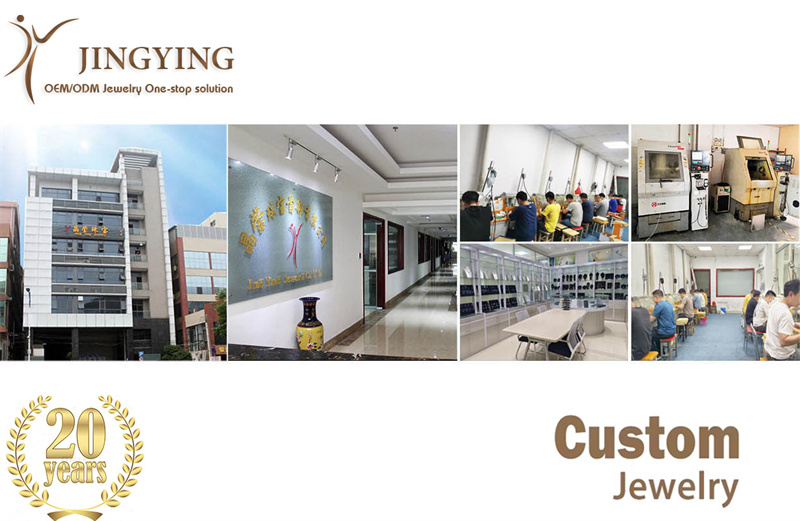
JINGYING was established in 1998 and has grown into a vertically integrated jewelry manufacturer operating four specialized facilities spanning 35,000 平方メートル, with a workforce of over 600 熟練した技術者と職人. The company serves more than 300 ブランド全体 45 国々, with production volume distributed across North America (42%), 欧州連合 (38%), the Asia-Pacific region (12%), およびその他の新興市場 (8%). This scale matters when evaluating lead times: a manufacturer with dedicated CAD teams, in-house casting, and multi-stage quality control can compress timelines in ways that smaller workshops cannot.
JINGYING's core offering centers on 925 sterling silver jewelry—rings, ネックレス, ペンダント, イヤリング, ブレスレット, and jewelry sets—with options for gold plating (vermeil and filled), rhodium finishing, そして宝石のセッティング. The company operates on an OEM/ODM model, meaning clients can supply their own designs, CADファイル, or even reference samples, and JINGYING handles the rest.
The Full Production Timeline: 概要
Based on JINGYING's own published guidance, the standard production timeline can be summarized as follows: sample development takes approximately 7 に 10 日, and mass production takes approximately 20 に 30 日. This means that from the moment a design is finalized and a deposit is paid, a client can typically expect to receive finished goods within four to six weeks, excluding shipping transit time. しかし, this headline figure masks significant variation. One JINGYING FAQ page states that the complete process—from design agreement and deposit to shipment-ready jewelry—usually takes about 8 に 12 週, noting that "before this, お客様にとって本当に完璧なデザインに到達するまでに、多少の時間がかかることもあります。".
The discrepancy between four-to-six weeks and eight-to-twelve weeks is not a contradiction; it reflects the difference between production time and total project time. Production time begins after the design is locked and the deposit is received. Total project time includes design iteration, CADのリビジョン, sample approval rounds, and client decision-making—factors that are often outside the manufacturer's control.
Stage-by-Stage Breakdown
ステージ 1: Design and CAD Development (3–7 Days, Extendable)
The process begins when a client submits a design idea, スケッチ, reference image, or CAD file. JINGYING's design team converts this input into a manufacturable 3D model using software such as RhinoGold or MatrixGold. For projects where the client provides an existing CAD file, JINGYING's technical team may spend significant time optimizing the design for manufacturing—adjusting wall thickness, reinforcing stress points, and running mold flow simulations. In one documented case involving a Dutch client's order of 25,000 sterling silver cross pendants, the technical team spent 120 hours refining the provided designs before achieving client approval after 28 日.
For simpler pieces, CAD development may be completed within three to seven business days. The critical variable here is the number of revision cycles. Each round of client feedback adds time, and design approval is the single most common bottleneck in the entire timeline.
ステージ 2: 3D Printing and Physical Prototype (24–48 Hours, Plus Post-Processing)
CADモデルが承認されたら, JINGYING uses SLA/DLP 3D printers to create a resin prototype within 24 に 48 時間, depending on the size and complexity of the piece. This physical prototype allows the client to assess the "感じる" and proportions of the design before committing to steel mold cutting. Post-processing—including support removal and polishing to achieve a flawless finish—adds additional time, though this is typically measured in hours rather than days. The client must approve this physical prototype before tooling begins, and this approval step can introduce delays if revisions are required.
ステージ 3: マスターモデルと金型製作 (変数, Typically 3–7 Days)
This stage represents the highest initial investment but determines the consistency of every subsequent unit. JINGYING uses CNC precision milling to cut a steel master model with 0.01mm precision, followed by rubber mold injection to create the production mold. For pieces with complex geometry—such as hinged earrings or multi-component designs—a multi-piece mold may be required because the design contains undercuts. The complexity of the mold directly affects the time required, with intricate pieces taking longer to tool.
ステージ 4: Wax Injection and Casting (1–3 Days for the Casting Cycle)
JINGYING operates a lost-wax casting facility. Liquid wax is injected into the rubber mold, and the resulting wax models are attached to a wax "木" for efficiency. The tree is then placed in a flask, covered with liquid plaster, and heated so the wax melts away, leaving a cavity. 溶融 925 sterling silver is then cast into the cavity via centrifugal or vacuum casting. For small-batch orders, this cycle can be completed in one to three days. For large-volume orders—JINGYING's monthly capacity reaches 100,000 pieces—casting may be staggered across multiple batches.
ステージ 5: 仕上げ, 石の設定, and Plating (3–7 Days)
キャスト後, the raw metal blanks undergo a series of finishing operations: 提出, 前研磨, and shaping. デザインに宝石が含まれている場合, hand-setting is performed using micro-inlay machines imported from Japan, which JINGYING states achieves a 99% no-lost-stone rate for 5A cubic zirconia stones. Plating is a two-step process: first a thick silver plating for surface smoothness, then the final gold or rhodium plating at thicknesses up to 3 ミクロン, designed to last at least one year under normal wear conditions. For pieces requiring oxidation or special finishes, additional processing time is added.
ステージ 6: 品質管理 (1–3 Days)
Quality control at JINGYING is not a single checkpoint but a multi-stage protocol embedded throughout production. Incoming materials are tested via XRF for metal composition. In-process checks include hourly plating thickness measurements. Final audit involves a three-person inspection team conducting 10% destructive testing. 石留め作品の場合, every item is checked individually with a steel needle to ensure stone security, and finished pieces are drop-tested from three meters to verify that stones do not fall out. This rigorous approach reduces defect rates but adds one to three days to the production timeline—a trade-off that most quality-focused brands accept willingly.
ステージ 7: パッケージングと配送 (2–14 Days, Depending on Method)
JINGYING offers independent packaging or custom branded packaging as per client requirements. Shipping is typically handled via DHL, UPS, or FedEx express services. お急ぎのご注文の場合, air express can deliver in approximately five days. Ocean LCL shipping takes around 28 days but costs significantly less for large volumes. A hybrid air-ocean option offers a middle ground at approximately 14 days transit time. In one documented case involving a Dutch client, production took 35 days and transit added 18 日, for a total lead time of 53 days from order confirmation to delivery.
What Factors Actually Determine the Timeline?
Understanding the stages is useful, but the practical question is what makes one project take four weeks and another take twelve. Several factors consistently emerge from JINGYING's project documentation.
設計の複雑さ is the most significant variable. Simple bands, basic pendants, and straightforward earrings move through the production line quickly. Pieces with multiple components, articulated mechanisms, 複雑なフィリグリー, or complex stone settings require more CAD time, more mold pieces, and more hand-finishing hours. A hinge mechanism, 例えば, demands a 0.2mm tolerance between the post and the hinge tube in the CAD model—a level of precision that adds engineering time upfront but prevents functional failures in production.
注文量 affects casting and finishing batching. Small orders of 30 に 100 pieces can be cast in a single cycle. Orders in the thousands require multiple casting runs, extended QC sampling, and more complex logistics planning. JINGYING's minimum order quantity is 30 pieces for most custom sterling silver work.
Stone sourcing and setting introduces variability. If the design calls for specific gemstones that must be sourced, availability and procurement time become factors outside the manufacturer's direct control. In-house stone setting, while faster than outsourcing, still adds days to the finishing phase.
Client approval speed is perhaps the most underappreciated factor. Every stage that requires client sign-off—design concept, CAD model, 物理プロトタイプ, pre-production sample—is a potential delay point. Brands that respond quickly to approval requests can compress the total timeline by one to two weeks compared to those that take days to review each submission.
Plating and finishing requirements also matter. Standard rhodium plating is relatively fast. Gold vermeil with a 3-micron thickness involves multiple plating passes and additional drying time. Two-tone finishes or special effects such as matte or brushed surfaces require additional handwork.
Can the Timeline Be Accelerated?
JINGYING has demonstrated the capacity for rapid turnaround on specific occasions. One case study documents a custom bow bracelet sample completed for a Singapore client in just three days. しかし, this kind of speed is exceptional and typically applies to samples of relatively simple designs where the client has provided a complete, production-ready CAD file.
For most projects, the most effective way to accelerate the timeline is to front-load client-side work. Providing clear design references, complete CAD files where available, and rapid feedback on prototypes eliminates the back-and-forth that extends project duration. Clients who arrive with a finalized design and a clear understanding of their specifications can often move from deposit to production in one to two weeks.
It is also worth noting that rushing quality control is counterproductive. JINGYING's QC protocols—XRF testing, hourly plating measurements, needle tests for stone security, and drop testing—are designed to prevent the costly returns and reputation damage that come from shipping defective goods. Brands that pressure manufacturers to skip these steps often pay for it later in customer complaints and reorders.
Custom Timelines Versus Standard Products
It is important to distinguish between fully custom work and modified standard designs. JINGYING maintains an extensive catalog of existing sterling silver jewelry designs—rings, ネックレス, イヤリング, bracelets—that can be customized with different stones, 終わります, or engravings. これら "customized standard" orders move through production significantly faster because no new tooling is required. The 20 to 30-day mass production timeline cited by JINGYING applies to orders that require new mold creation and full production setup. Repeat orders of the same design skip the CAD and tooling stages entirely, reducing production time to approximately 15 に 20 日.
The Bottom Line for Brands and Designers
For a brand planning a custom sterling silver jewelry launch with JINGYING, a realistic planning horizon is as follows: allow one to two weeks for design and CAD development, one week for prototyping and approval, one to two weeks for tooling and mold making, two to four weeks for mass production and finishing, and one to three weeks for quality control, パッケージング, そして発送. This yields a total of six to twelve weeks from project kickoff to delivered goods, with the lower end achievable for simple designs with fast client approvals and the upper end applying to complex, multi-component pieces or large-volume orders.
The most important insight is that the timeline is not fixed. It is a function of design decisions, communication efficiency, and quality expectations. JINGYING's published lead times—7 to 10 days for samples and 20 に 30 days for mass production—represent the manufacturing floor, not the ceiling. The difference between a smooth four-week project and a drawn-out twelve-week project usually comes down to how quickly and clearly the client and manufacturer align on what is being made.
For designers and brands willing to invest in thorough upfront design work and responsive communication, JINGYING offers a production capability that combines the precision of CNC machining, the craftsmanship of hand-setting, and the scalability of a 100,000-piece monthly capacity. The time it takes to make custom sterling silver jewelry at JINGYING is ultimately a reflection of the care put into the design and the clarity of the brief—not merely a measure of factory throughput.