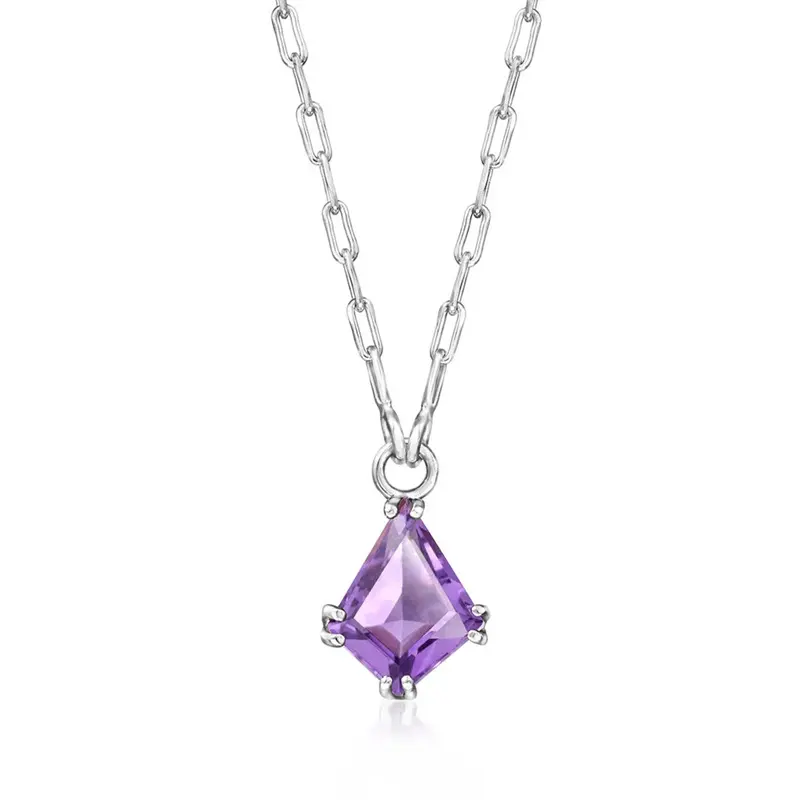
Jingying : O fabricante personalizado de colar com clipe de papel de ametista em formato de prata esterlina
OEM/ODM Jóias Fabricante Design personalizado suas próprias jóias
Vamos começar : mo@kingjy.com
Engineering Elegance: A Technical Guide to Producing Shaped Amethyst Paperclip Link Necklaces in Sterling Silver at JINGYING
1. Introdução: The JINGYING Manufacturing Ecosystem
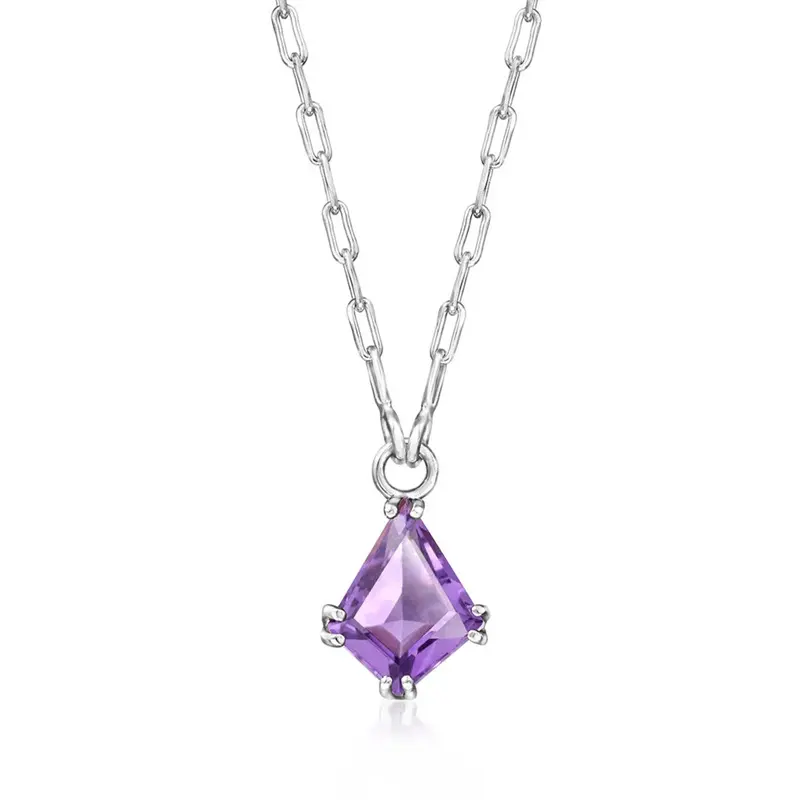
No mercado de joias contemporâneas, the convergence of geometric minimalism and organic gemstone accents has propelled the paperclip link necklace to iconic status. Unlike traditional rope or cable chains, the elongated, oval links of the paperclip chain offer a modern, architectural canvas. When combined with the velvety purple hues of shaped Amethyst—specifically rectangular (Por exemplo, 6x8mm), octagon, or heart-shaped cuts—the result is a piece that balances industrial chic with fine jewelry luxury .
Producing such a piece at scale requires more than just craftsmanship; it demands precision engineering, rigorous metallurgical control, and seamless workflow integration. Joias JINGYING, with over two decades of vertical integration, offers a proprietary ecosystem designed specifically for this task . By consolidating design, elenco, cenário de pedra, and finishing under one roof, JINGYING mitigates the risks of vendor fragmentation—such as mismatched alloys or solder seam failure—ensuring that the final "Shaped Amethyst Paper Clip Link Necklace" meets international durability and aesthetic standards.
This guide details the technical standard operating procedures (POPs) for manufacturing this specific SKU, leveraging JINGYING’s one-stop solution to optimize for quality, Eficiência de custo, e integridade estrutural .
2. Fase I: Projeto & Technical Architecture (CAD to Resin)
The first phase involves translating the artistic concept into a manufacturable blueprint. Unlike DIY crafts where paperclips are simply bent by hand, fine jewelry requires absolute uniformity in link geometry and prong placement .
2.1 Modelagem CAD & Link Geometry
Em jingying, designers begin by inputting the necklace parameters into Rhino 3D or MatrixGold. For a standard 16-inch necklace with a 2-inch extender, the CAD team models the "paperclip" links—typically measuring 4mm x 1.6mm in wire gauge—with a precise 7 links per inch ratio . The software calculates the pontos de estresse where the amethyst pendant will attach. For bezel-set heart amethysts (10x10mm) or prong-set octagons, the CAD model integrates a hidden bail or reinforced jump ring mount into the central link to support the 2.5 to 3-carat weight of the stone without deforming over time .
2.2 Structural Optimization
A common failure in paperclip chains is the "stretching" of the links. JINGYING’s engineering team adjusts the CAD file to ensure the aspect ratio (width vs. grossura) of the 925 Sterling Silver links is sufficient to withstand tensile pull tests. The pendant link is modeled with a 20% thicker cross-section than the chain links to act as a load-bearing anchor.
2.3 Prototipagem (Impressão 3D SLA)
Before metal is cast, the design is realized as a high-resolution resin prototype using SLA/DLP technology . Esse "cera" model allows the QC team to inspect the tactile feel of the paperclip edges—ensuring they are smooth but not overly rounded—and verify the fit of the amethyst stone. Only upon approval of the resin "looks-like, works-like" model does the project move to tooling .
3. Phase II: Fornecimento de material & Criação de Moldes
3.1 Metal & Gemstone Verification
JINGYING employs rigorous material science protocols. O 925 Sterling Silver is verified via Fluorescência de raios X (Xrf) teste to ensure compliance with legal hallmarking standards (92.5% prata pura, 7.5% liga de cobre), which is critical for the alloy’s fluidity during casting .
For the centerpiece, gemologists authenticate the Amethyst (February birthstone). Whether sourcing a 6x8mm rectangular white topaz border amethyst or a 10mm heart-shaped cabochon, each stone is scanned for inclusions that could cause fracturing during setting .
3.2 Rubber Mold Production
For high-volume production runs (50+ unidades), JINGYING cria um molde de borracha vulcanizada. The approved master model is pressed into uncured rubber under high heat. Uma vez curado, the mold is cut to create a sprue system, allowing for the injection of wax to create multiple "árvores" of paperclip chains simultaneously, ensuring every link is identical to the last .
4. Fase III: O processo de fundição (Cera Perdida)
This is the transformation from wax to solid metal. JINGYING utilizes vacuum-assisted or centrifugal casting to eliminate porosity.
-
Injeção de cera: Heated wax is injected into the rubber mold, creating dozens of replicas of the paperclip chain and pendant setting.
-
Montagem de árvore: The wax replicas are attached to a central wax sprue, formando um "árvore."
-
Investimento: The wax tree is placed in a flask and covered with a gypsum-based investment (gesso). It hardens around the wax.
-
Burnout: O frasco é aquecido em um forno (aprox.. 1350°F). A cera derrete ("cera perdida"), leaving a perfect cavity in the shape of the jewelry.
-
Elenco: Fundido 925 Sterling Silver is forced into the cavity via centrifugal force or vacuum suction.
The result is a raw metal "árvore" of paperclip chains and pendants. The metal structure is slightly malleable—perfect for the next stage .
5. Phase IV: Montagem de corrente & Cenário de pedra
Once the metal is cooled and cut from the tree, the assembly begins. This is the most critical stage for the "Paperclip" estética.
5.1 Link Preparation
While simple paperclip chains can be assembled by hand using pliers (as in DIY crafting), fine jewelry demands soldagem a laser of the links . Em jingying, each oval link is cut from the cast strip. The ends of the link are brought together and fused using a laser welder. This creates a seamless, closed link that will not open under tension, unlike mass-produced jump rings that may twist apart. The links are then tumbled to remove burrs.
5.2 The Pendant Assembly
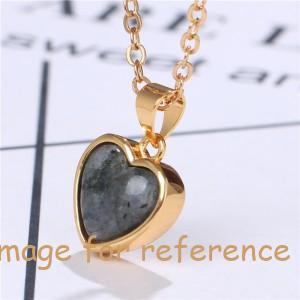
The Bezel Setting (Heart Shape): If the design is a heart-shaped amethyst (Por exemplo, Rosabella style), the stone is placed into its silver collet. Using a bezel roller or rocker tool, the technician carefully pushes the fine silver wall over the edge of the amethyst, securing it without the need for prongs .
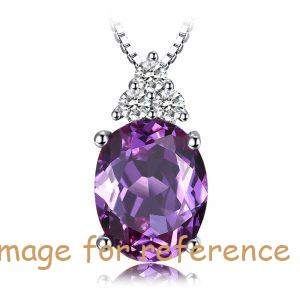
The Prong Setting (Octagon/Rectangle): For geometric amethysts with white topaz halos, o processo é mais complexo. The amethyst (6x8mm) is seated into a pre-cast basket. Using a graver, the technician raises the silver prongs over the crown of the stone. Posteriormente, 24 round white topaz stones are set via Configuração de pavimentação. A tiny bead of silver is raised over each 1.2mm topaz to hold it flush with the border of the amethyst .
5.3 Connecting Chain to Pendant
The final link in the chain is opened (twisted laterally, not pulled apart) using nylon-tipped pliers to avoid scratching the rhodium finish. It is threaded through the bail of the amethyst pendant and closed back into shape. The lobster clasp and extension chain are attached to the ends using soldered jump rings for security .
6. Fase V: Acabamento & Revestimento
Raw sterling silver tarnishes when exposed to air. To achieve the high-polish, white luster of modern paperclip necklaces, JINGYING employs a multi-step finishing line .
-
Pré-polimento: The assembled necklace is mounted on a rotating barrel filled with stainless steel shot (micropolishing). This burnishes the silver to a low sheen and hardens the surface.
-
Polimento das mãos: Technicians use a felt buffing wheel with rouge compound to reach the crevices of the paperclip links and the facets of the pendant setting.
-
Rodium Plating: The entire necklace is electroplated with a micro-layer of Rhodium—a platinum-group metal. This gives the necklace its brilliant white reflection and acts as a permanent anti-tarnish shield. This is a signature step for JINGYING’s silver collections .
7. Phase VI: Controle de qualidade (QC) & Garantia
Antes de embalar, the necklace undergoes JINGYING’s 7-Point Inspection Checklist .
-
X-Ray Imaging: A random sample from the batch is X-rayed to check for micro-porosity inside the casting that could weaken the links.
-
Pull Test: The clasp and links are subjected to a tensiometer to verify they can withstand the weight of the amethyst without deformation.
-
Magnified Visual Inspection (10x): Os inspetores verificam "Burrs" on the paperclip links that could snag clothing or hair.
-
Segurança de Pedra: The amethyst is probed with a carbide tool to ensure it does not rock or shift in the setting. For the pave topaz, um "scratch test" ensures no stones are loose .
-
Manchando resistência: A salt-spray test ensures the rhodium plating is uniform and free of pinholes.
8. Cadeia de mantimentos & Embalagem
Unlike dealing with separate vendors for chains, pedras, e revestimento, JINGYING ships the final product ready for retail.
-
Tempo de espera: Standard production for 100 units of the Shaped Amethyst Paperclip Necklace averages 25-35 dias .
-
Embalagem: The necklaces are placed in custom-branded luxury boxes with anti-tarnish strips. Each piece is shipped with a Hallmark Verification certifying the metal purity (925) and the genuine nature of the Amethyst .
9. Conclusão
Producing a Shaped Amethyst Paper Clip Link Necklace in Sterling Silver is a symphony of precision engineering and artistic vision. Em jingying, the process transforms raw materials through a tightly controlled loop of CAD design, automated casting, laser assembly, expert stone setting, and rhodium finishing.
By utilizing JINGYING’s one-stop solution, designers eliminate the logistical nightmare of managing separate factories for the chain, o fecho, and the stone setting. O resultado é um "ready-to-ship" necklace that offers the durability of a closed-link chain, the security of a professional bezel/prong setting, and the high-polish finish of rhodium, ensuring that the February birthstone remains secure and brilliant within its architectural silver frame .