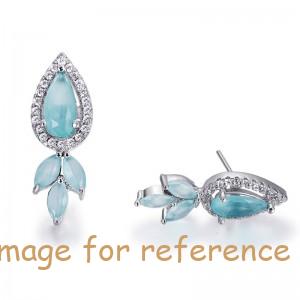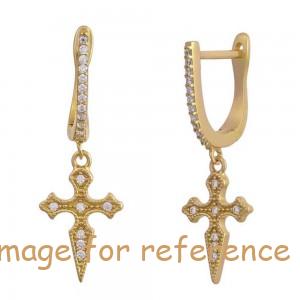
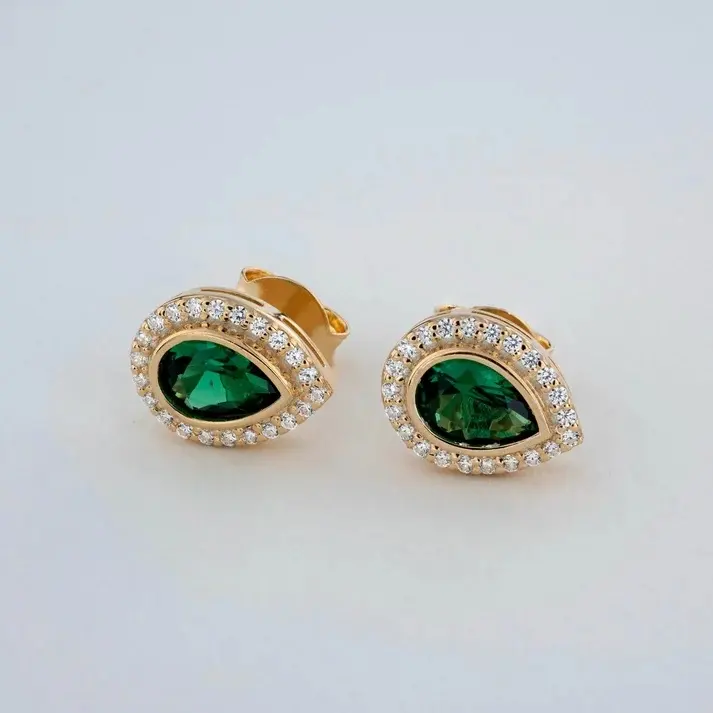
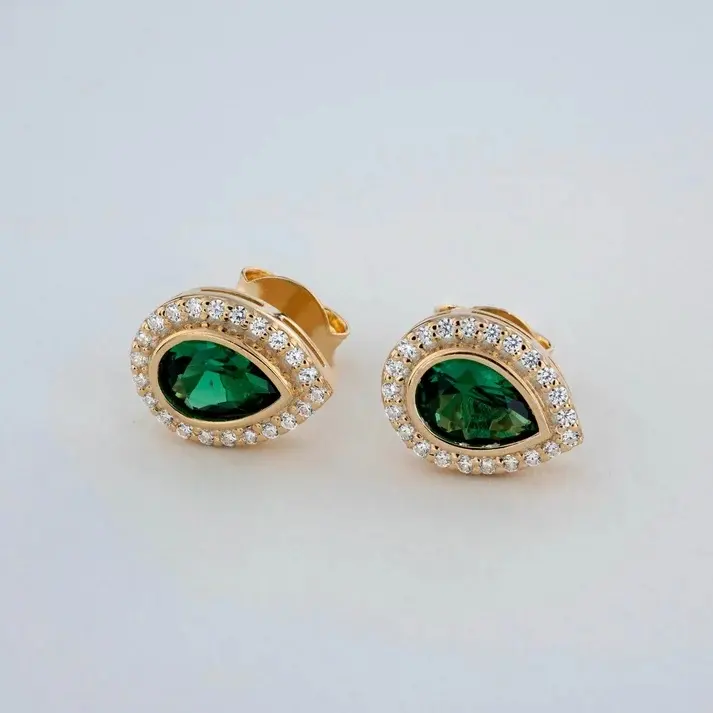
Egendefinert OEM ODM-service av Emerald Bezel Drop Stud øredobber i 8K/10K/14K solid gull
OEM/ODM Jewelry Produsent Design Custom Your Own Jewelry
La oss komme i gang : mo@kingjy.com
How to Produce Emerald Bezel Drop Stud Earrings in 8K/10K/14K Solid Gold at JINGYING
Introduksjon: The Confluence of Gemstone and Metal
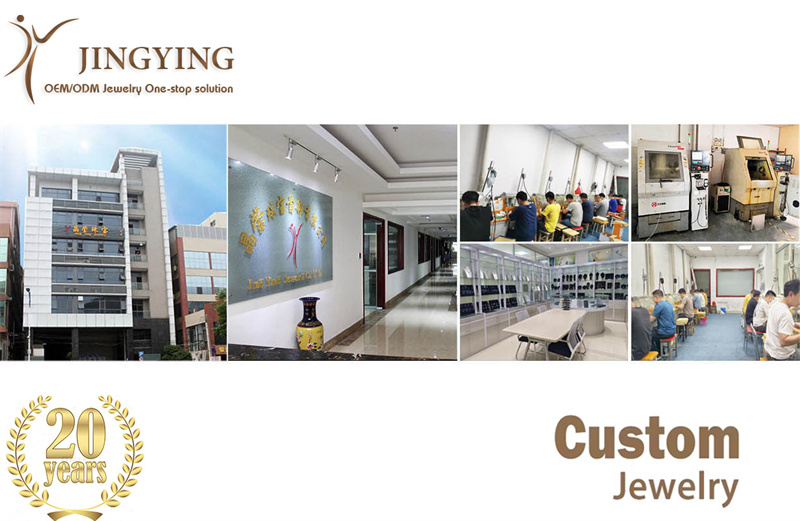
In the hierarchy of fine jewelry, few combinations possess the quiet authority of emerald and gold. The deep, verdant green of a well-cut emerald—with its characteristic jardin inclusions that attest to its natural origin—finds its most sympathetic setting in the warm glow of solid gold. Hos JINGYING, a manufacturer with over two decades of experience in OEM and ODM jewelry production, the creation of emerald bezel drop stud earrings in 8K, 10K, or 14K solid gold represents a sophisticated interplay of traditional craftsmanship and advanced manufacturing precision. Denne artikkelen gir en omfattende teknisk beskrivelse av hvordan JINGYING forvandler råvarer til et ferdig par av disse svært ettertraktede øredobber.
Den metallurgiske stiftelsen: 8K, 10K, og 14K solid gull
Før en enkelt CAD-fil åpnes, valget av gulllegeringen fastsetter parametrene for hele produksjonsprosessen. JINGYINGs ekspertise ligger i å navigere de spesifikke metallurgiske kravene til forskjellige karatgull for å oppnå en balanse mellom holdbarhet, farge, og bearbeidbarhet.
Forstå Karat-systemet
Solid gull, til forskjell fra gullbelagte eller gullfylte alternativer, danner den strukturelle kjernen til øredobbene. 24K gull (99.9% ren) er for myk for smykker som krever strukturell integritet for å sette steiner. Følgelig, JINGYING jobber med legeringer hvor gull blandes med andre metaller. 14K gull omfatter 58.3% gull, mens 10K gull inneholder 41.7% gull. 8K gull, ca 33.3% gull, offers the greatest durability but requires careful alloying to achieve an appealing color.
The Alloying Challenge: Color and Castability
Producing high-quality solid gold castings requires precise control over the alloy composition. JINGYING employs proprietary master alloy recipes to control both the color and the castability of the metal. For eksempel, achieving a rich yellow hue in 10K gold without a greenish tint involves blending palladium, sølv, and copper in specific proportions. For the casting process itself, the alloy must be optimized for fluidity to ensure it fills the fine details of the mold.
One critical aspect of gold casting is the management of oxygen. Porosity—microscopic air bubbles—is the enemy of high-integrity jewelry, particularly in prongs and bezel walls that must be structurally sound. JINGYING's expertise includes the use of oxygen scavengers in the alloy, such as germanium. In yellow karat gold casting alloys, germanium (up to approximately 1% etter vekt) serves as an effective deoxidizer, reducing the need for elements like silicon or boron that can create hard spots and compromise the final finish.
For the production of the drop stud earrings, JINGYING's technicians select the specific gold alloy based on the client's requirements. 14K gull, with its higher gold content, offers a richer color and is perceived as more luxurious, making it ideal for higher-end collections. 10K gull, being harder and more scratch-resistant, is chosen for pieces intended for daily wear or more active lifestyles.
The Design and Prototyping Phase: From Concept to Casting Tree
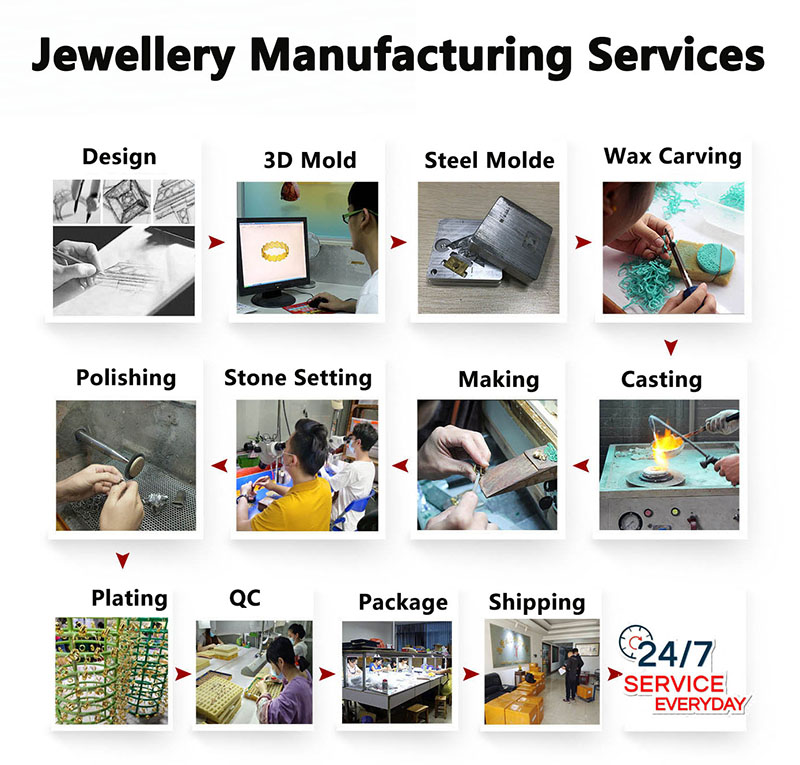
The journey from a designer's sketch to a physical product begins in the digital and physical modeling phase. JINGYING utilizes a structured "Collaborative Odyssey" to ensure that the client's vision is translated accurately into a manufacturable piece.
Fase 1: Design Translation and CAD Modeling
The process begins with the client providing a design concept. JINGYING’s in-house engineering team translates this into a 3D model using advanced CAD software like Rhino 7 or MatrixGold. This is not merely a visual exercise; it is a structural one. The engineers calculate the precise weight of gold required for the piece using density algorithms. They also engineer the "fixing pipes" and structural connections that will become the earring post and the drop element, ensuring the earring is balanced and wear-resistant. For a bezel-set emerald, the CAD model must define the exact dimensions of the emerald's seat to ensure a secure fit without placing undue stress on the gemstone.
Fase 2: Wax 3D Printing and Tree Assembly
Once the digital model is approved, JINGYING utilizes high-resolution 3D printers to create a physical prototype in wax. This is typically a "wax-like resin" printed via Stereolithography (SLA), achieving a layer thickness of approximately 33 microns for a smooth surface finish. The 3D-printed wax model is then meticulously cleaned, and support structures are removed.
Multiple wax models of the earring are then assembled into a "tre." Using a heated tool, the wax sprues are welded to a central wax rod, creating an arrangement that allows molten gold to flow into all cavities of the mold. JINGYING follows strict spacing protocols: hver modell på treet har en avstand på minst 2 mm fra naboene for å sikre tilstrekkelig metallflyt og en jevn støping.
Støpeprosessen for tapt voks: Gullmesterens fødsel
Vokstreet er offerelementet i støpeprosessen for tapt voks, en av de mest sentrale stadiene i smykkeproduksjon.
Skritt 1: Opprette investeringen (Gips) Mold
Det sammensatte vokstreet plasseres i en rustfri stålkolbe. Et fint plaster, kjent som "investering," blandes med vann og helles over treet. Denne gipsen plasseres deretter i et vakuum for å fjerne luftbobler - et kritisk trinn, ettersom all innestengt luft kan skape et tomrom i den endelige gullkastingen.
Skritt 2: Utbrenthet og forvarming
Investeringskolben, inneholder nå vokstreet, legges i en ovn. Dette "utbrenthet" fase er en gradvis, to-trinns oppvarmingsprosess. Først, temperaturen heves til 150–200°C for å myke opp voksen, allowing most of it to melt and flow out of the mold. The temperature is then increased to 300–400°C to vaporize any remaining wax residues. If any residue remains, it would carbonize during the final high-temperature phase (750–850°C), contaminating the mold cavity and ruining the surface finish of the casting. JINGYING often uses "Ashless" casting investment powder to further ensure that zero residue remains, guaranteeing a flawless surface for the molten gold.
Skritt 3: Melting and Casting the Gold
The precious metal—whether 8K, 10K, or 14K solid gold—is melted in a specialized crucible. JINGYING employs multiple methods, including electric induction melting (in an "electro-melting" maskin) or using an oxygen-acetylene torch for specific applications. To prevent oxidation and porosity, the melting is often performed in a protective atmosphere, such as argon gas, or within a sealed vacuum casting machine. The molten gold is then poured or forced (via vacuum or centrifugal force) into the hot investment mold. The high temperature of the flask (750–850°C) ensures that the gold remains fluid long enough to fill the thinnest sections of the mold, including the intricate bezel walls.
Skritt 4: Devestment and Quenching
Når gullet er avkjølt og stivnet, the flask is quenched in cold water. The plaster investment, still hot from the casting process, shatters upon contact with the water due to thermal shock. This crude yet effective method releases the gold tree from its plaster cocoon. Some residual plaster may remain, which is removed using high-pressure water or, in stubborn cases, a weak acid solution.
The Finishing and Assembly Process: Precision and Craft
The gold tree that emerges from the flask is a rough, interconnected cluster of emerald drop earring models. It is now time to transform it into a finished piece of jewelry.
Skritt 1: Cutting and Polishing
The individual earring castings are carefully cut from the tree, a process known as "de-sprueing." The small nubs where the sprues were attached are filed and sanded down. På dette stadiet, the rough castings undergo a series of mechanical and manual polishing operations to bring them to their final luster. The first phase involves grinding and polishing to remove major casting imperfections and to define the metal's shape. This is followed by a more delicate phase of "wheeling" og "hånd etterbehandling" using rotating wheels and abrasive compounds to create the desired finish—whether it be high-polish, matt, or satin. JINGYING's artisans employ a range of tools, from rotary wheels to "collet blocks" (or bezel blocks), to precisely size and shape the bezel setting for the emerald.
Skritt 2: The Bezel Setting
The defining feature of the earring is its bezel setting, a continuous metal rim that encircles and protects the emerald. Setting an emerald is a particularly delicate operation. I motsetning til diamanter, emeralds are more brittle (classified as Type III gemstones) and prone to cracking under pressure. JINGYING's master setters are adept at a technique that minimizes risk: the diamond halo (if the design includes one) is set first, and the emerald is added last. Dette "floating bezel" technique involves gently lowering the emerald into a meticulously polished seat and carefully pushing the soft gold bezel wall over the stone's girdle, rather than applying direct pressure to the stone itself.
Skritt 3: Assembly and Quality Control
Den endelige monteringen innebærer å lodde øredobbstolpen og sommerfuglen (push-back) passer til hoveddelen av øredobben. For øredobber, et hengsel eller et fast ledd er festet til stenderkomponenten. På hvert trinn, JINGYINGs kvalitetskontrollteam verifiserer arbeidet. De er opplært til å identifisere og korrigere overflatefeil, sikrer fargekonsistens og finishkvalitet sammenlignet med den godkjente prøven.
For endelig kvalitetskontroll, JINGYING sysselsetter en Sigma Metalytics Edelmetallidentifikator for å bekrefte renheten på 10K eller 14K til gullstykket. I tillegg, Røntgenfluorescens (Xrf) testing er en standardpraksis for å sjekke karatsammensetningen og tykkelsen på eventuell påført plettering, sikre at de oppfyller de avtalte spesifikasjonene. Først etter å ha bestått disse strenge inspeksjonene og en finale 100% visuell undersøkelse er øredobben anses klar for sin "DU" hallmark and final delivery.
Konklusjon
The production of emerald bezel drop stud earrings at JINGYING is a journey of meticulous transformation. It begins with the selection of a sophisticated 8K, 10K, or 14K gold alloy, engineered for the dual demands of castability and durability. It proceeds through the digital precision of CAD design and 3D wax printing, and culminates in the ancient alchemy of lost-wax casting. The rough castings are then brought to life through a blend of industrial polishing and artisanal hand-finishing, culminating in the delicate, risk-laden art of setting a natural emerald in a protective gold bezel. It is this synthesis of technical rigor, industrial efficiency, and refined craftsmanship that positions JINGYING as a premier manufacturer for custom fine jewelry, capable of delivering pieces that are as durable as they are beautiful.