
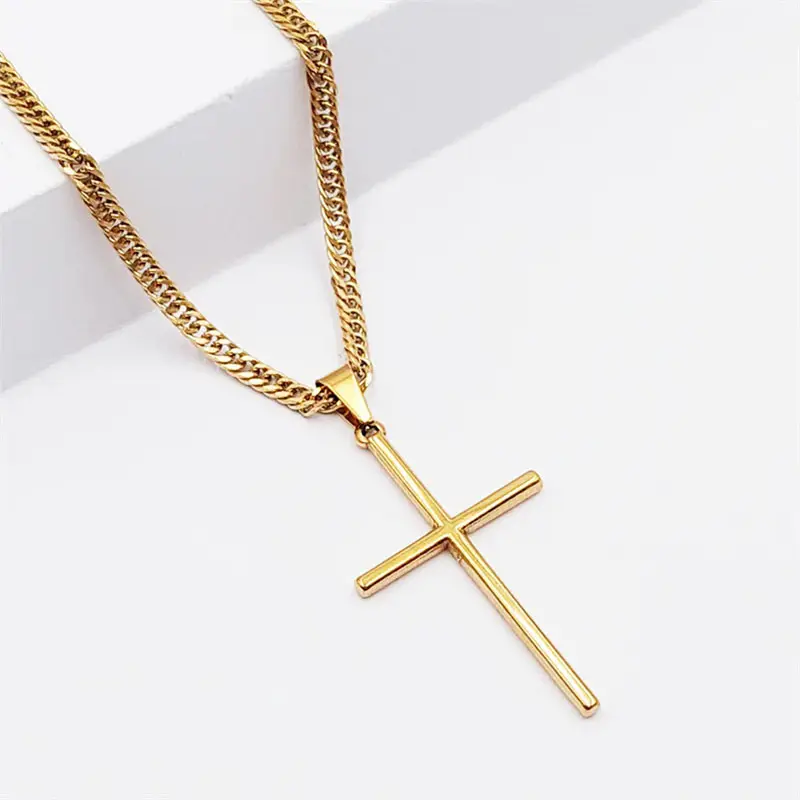
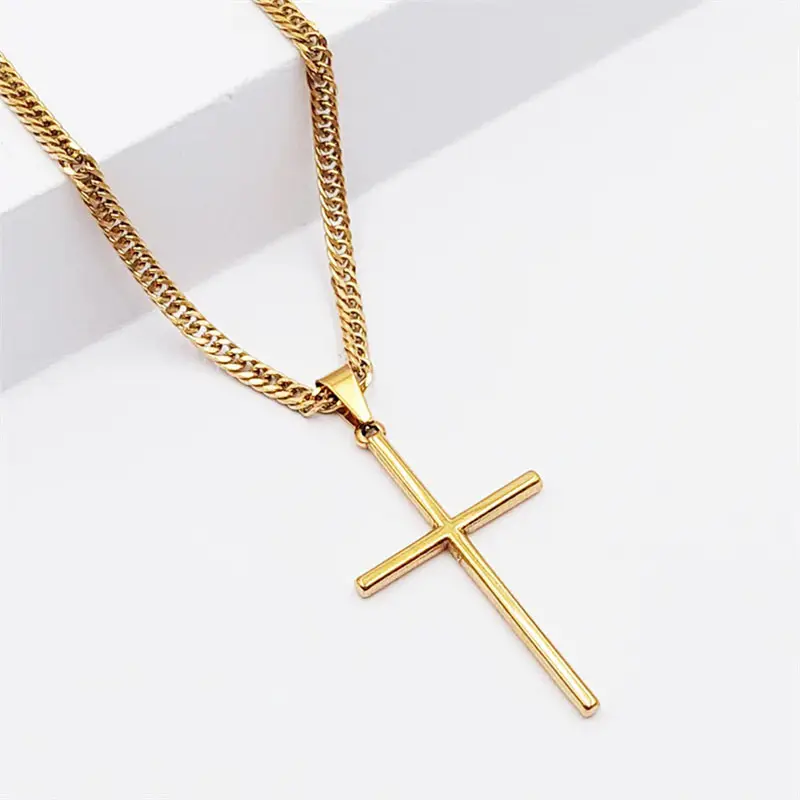
Processus personnalisé de collier croix unie chez JINGYING
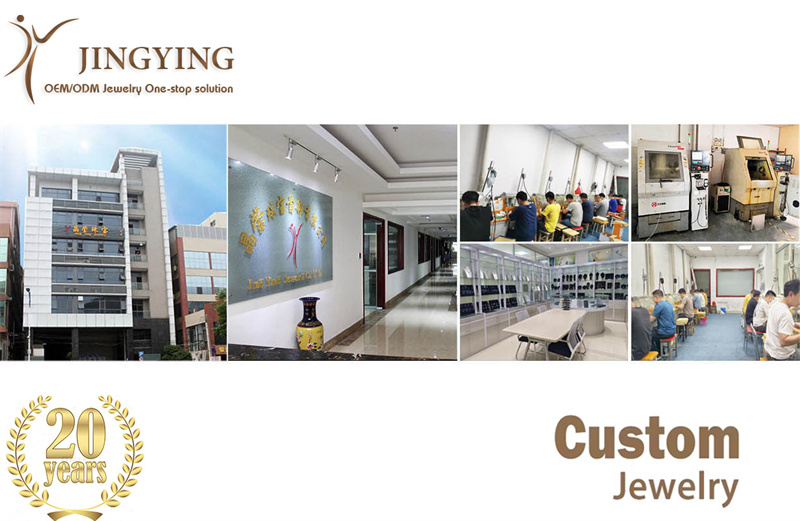
Conception du fabricant de bijoux OEM / ODM Custom Vos propres bijoux
Commençons : mo@kingjy.com
Beyond the Standard Cast: The Custom Process of Plain Cross Necklace at JINGYING
À l’ère de la production de masse, la notion de "plain" is often mistaken for "simple." Cependant, within the context of fine jewelry craftsmanship—particularly at a manufacturer like JINGYING—the word "plain" takes on a radical new meaning. It does not imply a lack of effort, but rather a mastery of restraint. The custom process of a plain cross necklace at JINGYING is a fascinating dichotomy: it is a journey that demands the highest level of technical precision to create an object that feels effortlessly minimal.
Pour un œil non averti, a plain cross is just a vertical bar intersecting a horizontal one. To the metallurgists and master jewelers at JINGYING, it is a geometry problem governed by physics, a spiritual symbol that rests against the human sternum, and a canvas of light and shadow.
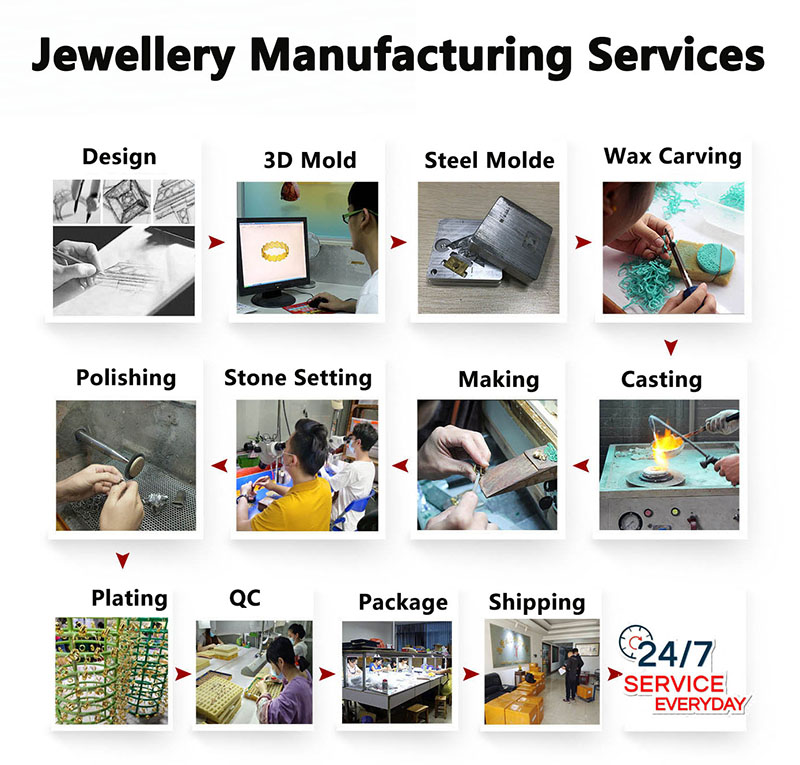
This guide details the seven-stage process of bringing a custom "plain" cross necklace to life, revealing the rigorous engineering, science du matériel, and hand-finishing required to achieve perfection where there is nowhere to hide.
Phase I: The Geometry of Faith (Consultation & Philosophy)
The process begins long before any metal is melted. À Jingying, the creation of a plain cross starts with a consultation that feels more like an architectural briefing . Since the design lacks decorative stones or intricate filigree to distract the eye, the proportions must be mathematically divine.
Defining the Archetype:
The first decision is historical. Is the client looking for a Latin Cross (the traditional elongated shape representing the Passion), un Greek Cross (with four equal arms, popular in Byzantine tradition), ou un Celtic Cross (the plain version with the characteristic ring intersection)?
Le "Doré" Ratio:
Because there are no gems, the visual weight of the pendant relies entirely on the ratio of the width to the length. JINGYING's CAD engineers often reference the Golden Ratio (environ 1:1.618) to ensure the cross looks "droite" to the human eye. Cependant, custom requests often defy this. A men’s plain cross might require a stouter, more robust "gros" sentir (un 1:3 rapport), while a women's pendant might be elongated and delicate (1:5 rapport).
Texture as the Only Ornament:
In the absence of stones, texture is king. The client must choose the "plain" finition:
-
Vernisque: Mirror-like reflectivity.
-
Satin/Brushed: A matte, velvety texture that diffuses light.
-
Marqué: A dimpled surface that catches light organically, giving a hand-forged feel .
Phase II: Alchimie matérielle (The Metal Selection)
JINGYING operates a zero-contamination policy in its workshops . Because a plain cross has no plating to hide imperfections (like porosity or pits), the base metal must be flawless.
-
Argent sterling (925): The most popular choice for plain crosses due to its bright white luster, which symbolizes purity. Utilisations de jinging 92.5% pure silver alloyed with copper for strength. Cependant, silver tarnishes. Pour un "plain" look that stays white, many clients upgrade to Placage de rhodium sur l'argent .
-
Or solide (14k & 18k): For a plain cross, gold offers warmth. Yellow gold emphasizes the spiritual glory, while white gold offers modern austerity. Or rose, with its copper undertones, is often requested for crosses meant to symbolize the love of Christ or a memorial for a spouse .
-
Platine: The ultimate choice for a "plain" héritage. It has a heavy, sensation substantielle (gravité spécifique) that cheap metals lack. Its natural white sheen never fades or requires plating .
Phase III: The Digital Crucible (GOUJAT & 3D Prototypage)
Once the math is calculated, the design enters the digital realm. À Jingying, the mantra is "measure twice, cast once."
Engineers import the specifications into advanced CAD software. Ici, they analyze the intégrité structurelle. A common issue with plain cross necklaces is the junction—where the vertical arm meets the horizontal arm. If the interior corner is a sharp 90-degree angle, it creates a stress riser. Under tension, a silver or gold cross could snap at the neck.
To prevent this, JINGYING's engineers introduce a microscopic radius fillet (a slight curve) in the internal corner. This distributes the weight and stress across the metal, ensuring the "plain" cross lasts a lifetime .
The 3D Render:
The client receives a 360-degree, high-definition video of the digital cross. Because there is no stone setting to correct minor asymmetries, the render is scrutinized for symmetry. Is the left arm exactly the same length as the right? Is the texture consistent? Only upon digital sign-off does the process move forward .
Phase IV: The Wax Revolution (Printing the Temporary)
With the file approved, JINGYING creates a physical object using high-resolution 3D printing—specifically, un Sla (Stéréolithmicromographie) Resin Printer .
The printer builds the cross in liquid resin, layer by layer (often at 25-micron resolution). Cette résine "cire" is the exact double of the final silver or gold piece.
Why wax matters for a plain cross:
In a gem-set piece, the wax is a placeholder. In a plain cross, the wax is a test. The jeweler checks the weight and the "hand feel." Does the edge feel sharp? Is the satin texture rough enough to hold a brush finish? The wax can be sanded, scraped, or polished by hand immediately—a process much cheaper and faster than correcting metal mistakes later .
Phase V: The Lost-Wax Casting (The Baptism by Fire)
The resin cross is attached to a rubber base with a "arbre" of wax wires. It is then inserted into a flask filled with a plaster-like investment material.
-
The Burnout: The flask is placed in a kiln at extreme temperatures (environ. 750°C/1382°F). The resin wax vaporizes completely, leaving a perfect, negative-space cavity of the cross inside the plaster.
-
The Casting: JINGYING utilizes centrifugal or vacuum casting machines . Argent fondu (960° C) or gold is melted in a crucible. The machine spins the flask at high speeds, forcing the liquid metal into every microscopic crevice of the cavity.
For the "plain" croix, the casting team pays special attention to the edges. If the metal cools too slowly, the sharp edges of the cross will round off. If it cools too fast, it might crack. JINGYING’s temperature controls are calibrated to ensure the final raw casting comes out of the flask with razor-sharp definition .
Phase VI: The Art of Subtraction (The Finishing Line)
C'est là que le "plain" cross is either made or broken. The raw casting is covered in a black oxide from the hot plaster and has a small "sprue" (a nub where the metal flowed in).
A master jeweler takes over. They clip the sprue and file it down flush with the metal. This is done under magnification. On a plain cross, any file mark left on the surface is permanent. The jeweler must blend the repair area seamlessly into the surrounding texture.
Chasing the Lines:
If the client ordered a high-polish cross, the jeweler begins with a 400-grit sandpaper, moving up to 600, alors 1000, alors 2000, and finally to a polishing wheel with rouge compound. The goal is a mirror finish.
If the client ordered a brushed/satin finish, the jeweler uses a fiber brush or abrasive stone to draw perfectly straight, unbroken lines across the surface of the metal. On a cross, these lines must flow in the direction of the arms—vertical lines on the stem, horizontal lines on the arms—to create a flattering, slimming effect .
Phase VII: The Quality Crucible (QC & Caractéristique)
Before the chain is attached, the necklace enters the Quality Control phase. Pour faire du jinging, a custom plain cross undergoes a "Zero Defect" politique .
-
Spectrométrie XRF: The cross is placed under an X-ray gun. This verifies the metal purity (Par exemple, "Are you sure this is 14k gold and not 13.5k?"). It ensures the alloy mix is exact.
-
Micro-Inspection: The piece is viewed under a 10x loupe. The inspector looks for "pitting" (tiny holes from gas bubbles during casting). Even one pit ruins a satin finish.
-
Contrôle de porosité: Using X-ray imaging if necessary, they check for internal bubbles that could weaken the metal over time .
Upon passing, la croix est estampillée. Sur le dos, une petite gravure au laser marque le contenu en métal ("925" ou "750") et souvent la marque du fabricant JINGYING .
Phase VIII: La présentation (Au-delà du pendentif)
Enfin, une simple croix a besoin de sa chaîne. JINGYING propose différents styles de chaînes, mais pour une croix simple et minimaliste, le Chaîne câblée (liens ovales classiques) ou le Chaîne de boîte (liens carrés créant une douceur, sensation tubulaire) sont préférés .
La croix est enfilée sur la chaîne. La caution (la boucle en haut de la croix) est doucement pressé pour combler l'écart, mais pas trop serré, car il doit osciller librement.
Conclusion: Le grand silence du minimalisme
Le processus personnalisé d'un collier croix uni chez JINGYING est un exercice de discipline. Parce que le design supprime la distraction des pierres précieuses, le savoir-faire sous-jacent est exposé. Il n'y a pas de griffe pour cacher une pierre tordue; il n'y a que la ligne, l'angle, et la lumière.
Pour le client, tenir le produit fini est une révélation tactile. C'est plus lourd que prévu. Les bords sont tranchants là où ils devraient être, doux là où le corps les touche. C'est "plain" seulement dans la conception, mais d'une exécution infiniment complexe - un véritable témoignage de l'idée que dans la fabrication moderne, moins est infiniment plus difficile à réaliser.