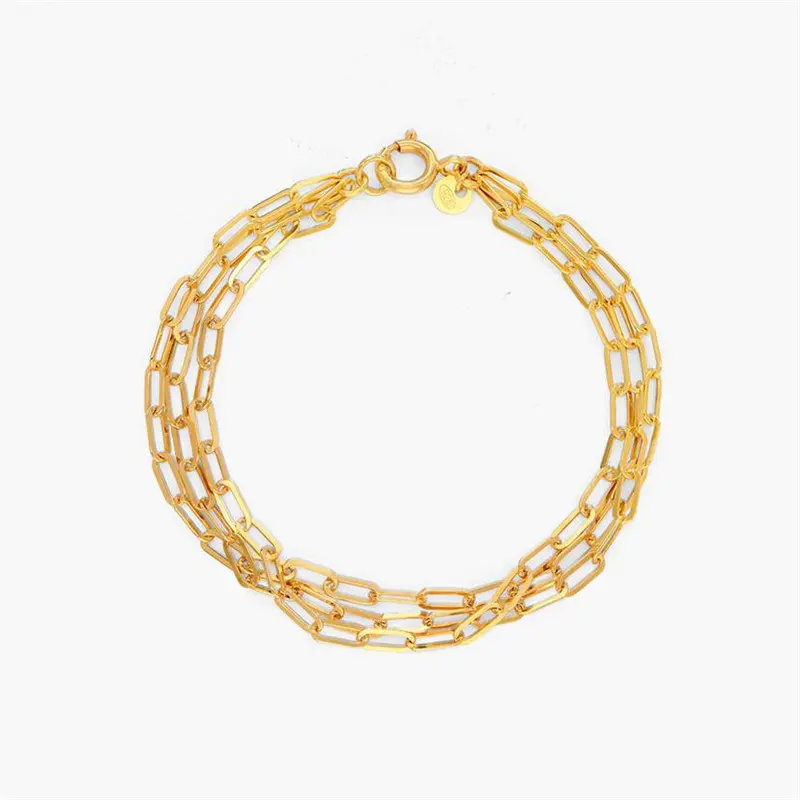
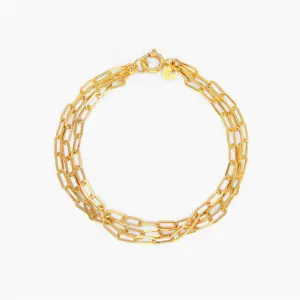
Jingying :Der maßgeschneiderte Hersteller von dreilagigen Büroklammer-Kettenarmbändern aus Gold-Vermeil
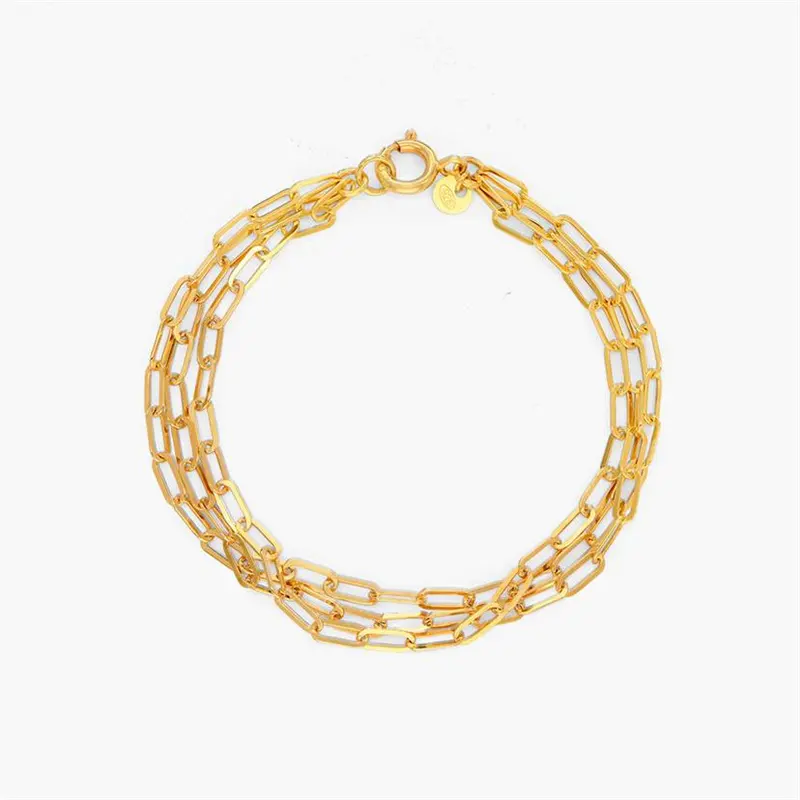
OEM/ODM -Schmuckhersteller Design Custom Ihr eigener Schmuck
Lassen Sie uns anfangen : Mo@kingjy.com
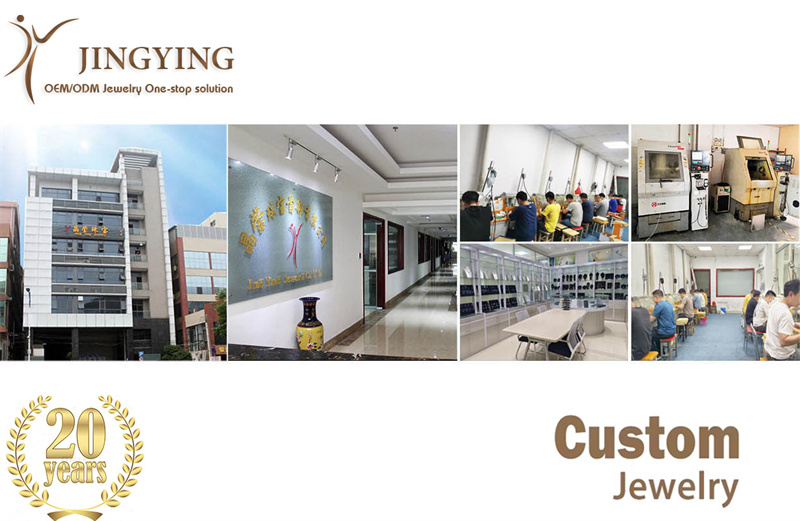
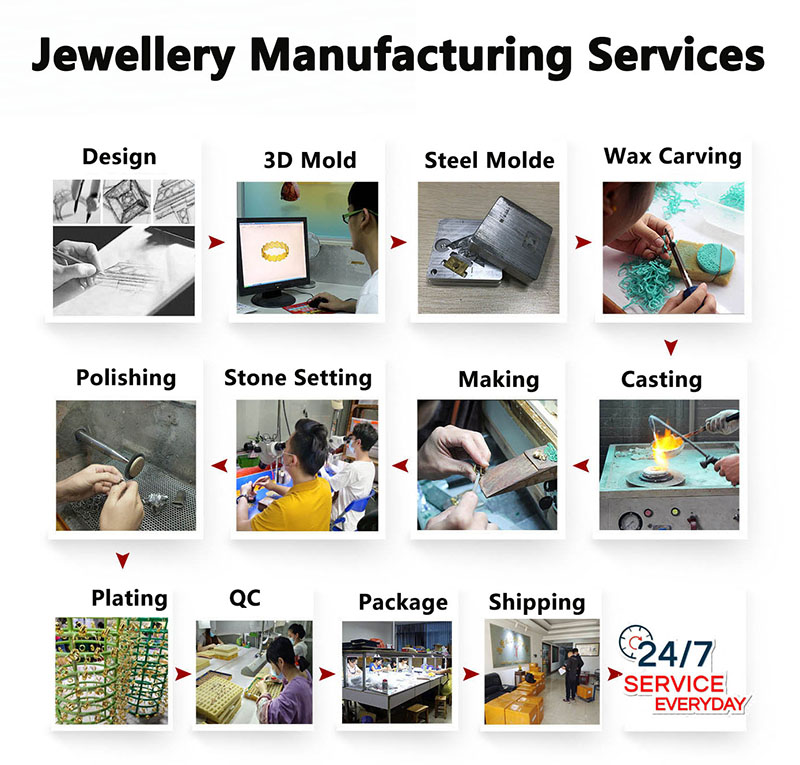
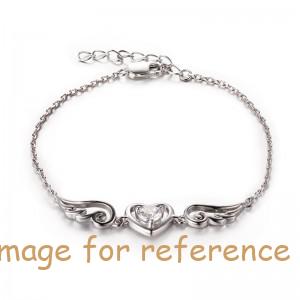
Die Kunst der Präzision: Manufacturing a Three-Layer Paperclip Chain Bracelet in Gold Vermeil at JINGYING
Einführung
In der wettbewerbsintensiven Welt des Modeschmucks, the paperclip chain has emerged as a dominant trend, celebrated for its modernist aesthetic and substantial feel. When stacked in three layers, this design transforms from a simple accessory into a statement of architectural elegance. At the forefront of producing such high-quality, trend-driven pieces is JINGYING Schmuck, a Guangzhou-based manufacturer with over 23 years of industry expertise .
Herstellung a Three-Layer Paperclip Chain Bracelet in Gold Vermeil is a process that demands a fusion of precision engineering and delicate handcraft. Gold Vermeil (ausgesprochen "Ver-May") is not standard gold plating; it is a specific, high-end electroplating process requiring a sterling silver base coated with a thick layer of gold (mindestens 2.5 Mikrometer) . Dieser Artikel bietet einen umfassenden Überblick, step-by-step technical breakdown of how JINGYING produces these bracelets, from raw metal to the final polished, export-ready product.
Abschnitt 1: Defining the Product and Material Standards
Before delving into machinery, it is vital to understand the material specifications that define a JINGYING vermeil piece. Unlike cheap fashion accessories that use brass or copper, JINGYING adheres to strict international standards for vermeil.
1.1 Das unedle Metall: 925 Sterlingsilber
The foundation of the bracelet is 92.5% reines Silber gemischt mit 7.5% Legierung (Normalerweise Kupfer) für Haltbarkeit. JINGYING sources high-purity silver to ensure that the bracelet does not trigger skin allergies and provides a solid, heavy feel.
-
Why not brass? Authentic Vermeil erfordert Sterlingsilber. Brass or copper bases are merely "vergoldet," which wears differently and can turn skin green .
1.2 The Paperclip Geometry
Der "three-layer" design refers to three distinct chains interlocked or worn together, or one long bracelet folded into three strands. The links are elongated ovals (resembling a paperclip) with specific dimensions:
-
Link Length: 12mm – 18mm
-
Wire Thickness: 1.8mm – 2.5mm
-
Textur: The outer edges are slightly flattened (facettiert) to catch light, while the inner curve remains rounded for comfort .
1.3 The Vermeil Plating Standard
JINGYING defines Vermeil by two specific metrics:
-
Goldreinheit: Minimum 14K, though 18K is common for luxury lines.
-
Dicke: Mindestens 2.5 Mikrometer Gold. (By comparison, Standard "Blitzbeschichtung" is often only 0.05 Zu 0.5 Mikrometer) .
Abschnitt 2: The Manufacturing Workflow at JINGYING
Producing this bracelet involves a linear workflow: Design & Molding -> Casting -> Pre-Finishing -> Electroplating -> Assembly -> Qualitätskontrolle.
Schritt 1: Design & 3D Modellierung (CAD)
Every bracelet begins as a digital wireframe.
-
Software: JINGYING uses RhinoGold and MatrixCAD.
-
Der Prozess: Designers create a 3D model where the three chains are rendered simultaneously to ensure they interlock perfectly without tangling. The tension between the links is calculated digitally.
-
Ausgabe: The file is sent to an SLA (Stereolithographie) 3D printer to create a high-resolution resin "Master" pattern .
Schritt 2: Casting verlorene Wachs (Creating the Silver Base)
Once the resin master is approved, it is encased in a plaster-like investment material. The mold is heated in a kiln to 750°C, burning out the resin and leaving a perfect cavity. Geschmolzen 925 Sterling Silver is then injected via vacuum or centrifugal force into the cavity .
-
Ergebnis: A "sprue tree" filled with raw, matte-gray silver paperclip links and clasps.
Schritt 3: Der "Vorabbau" Polieren
Raw cast silver has a "Gusshaut" – a dark, oxidized layer. You cannot plate gold directly onto this.
-
Stolpern: The links are placed in a rotary tumbler with stainless steel shot and a burnishing compound for 4-8 Std.. This work-hardens the silver and smooths the surface .
-
Handpolieren: Skilled artisans use flexible shafts and bristle brushes to reach the innen of the paperclip ovals. Any rough spot left on the silver will look like a black dot once gold is plated over it.
Schritt 4: The Gold Vermeil Electroplating Process
This is the most critical scientific phase. JINGYING utilizes electroplating tanks specifically reserved for vermeil production to avoid cross-contamination with base metals.
The Step-by-Step Plating Line:
-
Ultraschallreinigung: Links are submerged in a heated ultrasonic vat to remove finger oils and dust.
-
Aktivierung: The silver is dipped in an acid solution to remove the natural oxide layer, ensuring the gold adheres chemically.
-
Copper Flash (Optional): A micro-layer of copper may be added to improve adhesion.
-
Das Goldbad:
-
The bracelets are racked on a spinning cathode (negative Ladung).
-
Solid gold plates (Anoden) dissolve in the cyanide-based electrolyte solution.
-
The Vermeil Rule: JINGYING leaves the bracelets in the tank for a specific duration (ca. 60-90 Minuten) um die Ebene aufzubauen 2.5 Mikrometer. Dies ist deutlich länger als die Standardbeschichtung (was Sekunden dauert) .
-
-
Farbinspektion: Der Schmuck wird entfernt. Wenn der Kunde 18 Karat Gelbgold bestellt hat, Die Farbe wird anhand einer Kontrollprobe überprüft.
Schritt 5: Montage & Die "Dreischichtig" Konstruktion
Einmal plattiert, Die einzelnen Glieder werden zusammengesetzt. Die Herstellung eines dreischichtigen Armbands erfordert sorgfältige Aufmerksamkeit für den Verschluss.
-
Linkweben: Techniker verwenden eine nicht scheuernde Nylonzange, um die drei Ketten an den Enden zu verriegeln. Die mittlere Kette ist normalerweise etwas kürzer als die beiden äußeren, um eine zu bilden "umarmen" Wirkung auf das Handgelenk.
-
Verschlussbefestigung: Ein Heavy-Duty Karabinerverschluss wird über einen gelöteten Biegering befestigt. Denn die Kette ist dreisträngig dick, JINGYING verwendet häufig einen magnetischen Kastenverschluss oder einen größeren doppelseitigen Karabinerverschluss, um sicherzustellen, dass das Armband nicht herunterfällt, wenn eine Seite hängen bleibt .
Schritt 6: Das letzte Finish (Laser & Polieren)
-
Laserschweißen: If links need to be closed permanently, JINGYING uses laser welders rather than torches. Lasers provide localized heat without melting the surrounding gold vermeil layer.
-
Rhodinization (Optional): For white gold versions, a final layer of Rhodium is applied for brightness.
Abschnitt 3: Quality Control and the "Zugtest"
Bei Jingying, a paperclip bracelet is only as strong as its weakest link. The factory employs rigorous testing:
3.1 Haftungstest (The Tape Test)
High-quality vermeil does not flake. QC technicians apply high-tack tape to the bracelet and rip it off. If gold flakes come off, the batch is rejected and stripped back to silver.
3.2 Überprüfung der Dicke (RFA-Spektroskopie)
JINGYING uses X-Ray Fluorescence (Xrf) guns on random samples. The device reads the exact micron thickness of the gold layer. For vermeil, it must read >2.5 Mikrometer .
3.3 Zugfestigkeit
A machine pulls the bracelet apart. The three-layer chain must withstand up to 10kg of force without snapping. This is particularly important for paperclip links, which can bend open under stress if not properly soldered .
3.4 Salzsprühtest
To simulate years of wear, samples are placed in a salt spray chamber. This tests the porosity of the gold. If the silver underneath is exposed due to microscopic pinholes, the bracelet will tarnish from the inside out.
Abschnitt 4: WARUM JINGYING? Capability and Scale
Manufacturing this specific bracelet requires infrastructure that small workshops lack.
4.1 E-Beschichtung (Anlaufschutz)
After the gold is applied, JINGYING offers an optional E-Beschichtung (Electrophoretic deposition). This is a microscopic, transparent film applied over the gold. It prevents the bracelet from scratching and keeps the "Hochglanz" shine for years, protecting the soft 18K gold layer.
4.2 Low MOQ for Vermeil
Im Gegensatz zu massivem Gold, which requires massive capital investment, JINGYING allows for low Minimum Order Quantities (MOQS) für Vermeil, sometimes as low as 50 Stücke pro Design. This allows brands to test the "Three-Layer Paperclip" trend without over-committing .
4.3 Anpassungsoptionen
While the "three-layer" design is standard, JINGYING offers variations:
-
Gravur: Using fiber lasers to engrave logos or names onto the flat surface of the paperclip links .
-
Zweifarbig: Combining a Rose Gold outer chain with a Yellow Gold inner chain.
-
Weighting: Adding internal weight to the hollow silver castings to give the bracelet a "massives Gold" heft.
Abschluss
Herstellung a Three-Layer Paperclip Chain Bracelet in Gold Vermeil at JINGYING is a journey of 23 Schritte, blending the ancient art of lost-wax casting with the precise science of electrochemistry.
The final product offers the best of both worlds: the weight and skin-safe nature of Sterling Silver, combined with the lustrous, rich color of 18k Gold, protected by a substantial 2.5-micron layer. For a brand looking to offer luxury at an accessible price point, JINGYING provides the technical expertise to produce these complex, layered designs at scale, ensuring every link bends correctly, every clasp catches securely, and every bracelet gleams with the quality of vermeil. .
Technical Specifications Summary Sheet
| Merkmal | Specification at JINGYING |
|---|---|
| Grundmaterial | 925 Sterlingsilber (92.5% Ag / 7.5% Cu) |
| Link Style | Elongated Paperclip / Curb hybrid |
| Layers | Triple Strand (Independent interlocking) |
| Vorabbau | Tumbled + Spiegelpolitur (Manual) |
| Beschichtungstyp | Elektrolyse (Cyanide Bath) |
| Goldreinheit | 14K / 18K / 24K (Gelb, Rose, or White) |
| Vermeil Thickness | 2.5 Mikrometer (Min) |
| Plating Duration | 60-90 Minuten |
| Schließung | 18mm Lobster Claw or Magnetic Box Clasp |
| QC Standard | XRF Tested, Salt Spray Resistant |